
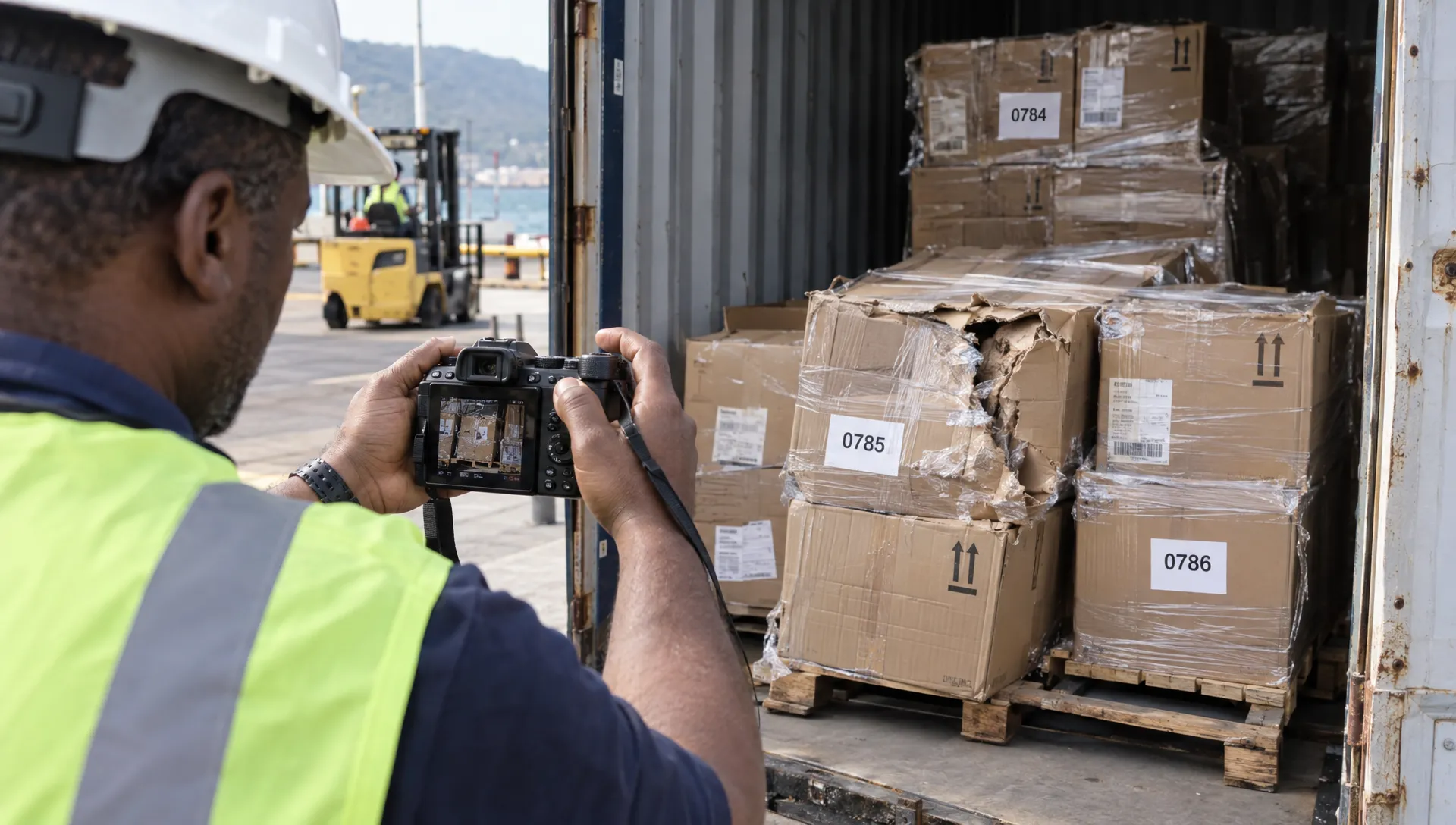
Cargo damage claims in Jamaica often turn on evidence collected before the goods are unpacked, moved or discarded. A wet carton or crushed pallet may show that something went wrong, but recovering the loss requires a clearer record: what was shipped, its condition, who handled it and how much damage resulted.
For importers, exporters and their insurers, the immediate priority is to preserve that record while protecting the remaining cargo. This guide explains what to collect, whom to notify and which legal questions need early attention. It focuses on commercial sea cargo, including containerised shipments, although inland transport and storage arrangements may also affect responsibility.
What to do when damaged cargo arrives
Treat discovery as both an operational incident and a potential claim. Warehouse staff, the logistics team and the insurer should work from the same factual account rather than separate, inconsistent descriptions.
Take these steps promptly:
Record the condition before further handling: Photograph the container exterior, identification number, seal, doors, packaging and visible damage. Continue recording as unloading reveals the condition inside.
Make accurate delivery remarks: Describe visible damage or shortages on the delivery record. If inspection is incomplete, record that fact rather than confirming that everything arrived in good condition.
Notify the relevant parties: Send factual written notices to the carrier and any other potentially responsible contractor through the required channels. Notify the cargo insurer under the policy requirements.
Arrange an appropriate survey: Seek a suitably qualified cargo surveyor, particularly for substantial losses, perishables or disputed causes.
Protect goods and evidence: Segregate affected stock, prevent avoidable deterioration and retain relevant packaging, samples and records where safe and lawful.
Avoid guessing about the cause in the first notification. “Water staining observed on 14 cartons during unloading” is more useful than asserting seawater ingress before testing or inspection.
If goods present a contamination, fire or other safety risk, safety takes priority. Document any urgent disposal or intervention and obtain appropriate professional guidance.
Identify the claimant and the responsible parties
The business receiving the goods is not necessarily the party entitled to sue every participant in the journey. Establish who contracted for carriage, who holds the relevant transport document and whether claim rights have transferred.
Review the bill of lading or sea waybill, purchase contract, freight arrangements and insurance documents together. A freight forwarder may have acted as an agent or contracted as a carrier. A shipping line, terminal, warehouse operator and inland haulier may each have different obligations and defences.
The sale contract also matters. Incoterms rules help allocate delivery obligations, costs and risk between buyer and seller, but they do not by themselves establish who can sue the sea carrier. Ownership, risk, insurance cover and rights under the carriage contract are related but distinct questions.
For the wider jurisdictional and procedural context, our guide to admiralty claims in Jamaica explains why the parties, contracts and available remedies should be assessed together.
The core evidence for cargo damage claims in Jamaica
A useful evidence file follows the shipment from preparation to delivery. It should help establish the condition of the goods at relevant stages without assuming that every missing record defeats the claim.
Evidence | What it can help establish | Important limitation |
Bill of lading or sea waybill | Shipment details, carriage terms and the named parties | Carrier identity and incorporated terms still require review |
Packing list and commercial invoice | Description, quantity and invoiced value | They do not independently prove sound condition at loading |
Pre-shipment inspection and stuffing records | Condition, packaging and loading arrangements | Their value depends on what was actually inspected and recorded |
Delivery receipt and interchange records | Handover times, recorded condition and custody changes | General remarks may miss concealed damage |
Photographs, video and survey findings | Nature, extent and possible cause of damage | Timing, context and authenticity affect their usefulness |
Temperature logs and equipment records | Conditions during refrigerated transport | Gaps, sensor location and equipment accuracy need assessment |
Repair, salvage and disposal records | Actual loss and steps taken to reduce it | Expenditure must still be connected to the incident and reasonable |
Evidence of condition before shipment
Collect factory quality checks, packing photographs, inspection certificates and records showing how the goods were secured. For refrigerated cargo, preserve pre-cooling records, loading temperatures and the agreed carriage instructions.
A clean bill of lading generally concerns the apparent order and condition of the goods or packaging as received. It is not a guarantee that concealed contents were free from defects. Reservations concerning shipper-packed containers or unverified quantities may also matter.
Where goods were damaged before loading or packaging was unsuitable, that can affect both liability and the explanation for the loss. Preserve unfavourable material as well as supporting evidence so that advisers can assess the case accurately.
Evidence of custody and handling
Build a timeline covering collection, terminal receipt, loading, transshipment, discharge, storage and final delivery. Use dates, times, locations and document references rather than relying on recollection alone.
Container interchange records, gate records and delivery documents can help identify custody changes. A matching seal number is useful evidence about access, but an intact seal does not prove that the contents remained undamaged throughout transit.
If CCTV, terminal records or equipment data may be relevant, request preservation quickly. Such material may be overwritten or held by a business that has no reason to retain it indefinitely.
Photographs and digital records
Take wide photographs showing the overall scene before moving to close-ups. Connect damaged items to pallet labels, carton numbers or other identifiers so that the images can be matched to the packing list.
Keep original files with available metadata. Do not rely only on compressed messaging-app copies or edited images. Preserve relevant emails, messages and attachments, including instructions that might explain a temperature setting or delivery delay.
Our guidance on building a court-ready evidence file explains how to organise originals, timelines and supporting documents without losing their context.
What a cargo survey should establish
A survey should do more than confirm that goods look damaged. Its scope should address the cargo type, possible causes, extent of loss and reasonable options for reducing it.
For water damage, a surveyor may examine staining patterns, packaging, container condition and appropriate test results. For refrigerated goods, the assessment may require temperature data, loading condition, ventilation settings, machinery records and evidence about delays. A temperature excursion alone does not necessarily establish when the goods became unusable or who was responsible.
Give potentially responsible parties a reasonable opportunity to attend an inspection where practicable. Record invitations, responses and attendance, but do not allow the process to cause avoidable deterioration or compromise safety.
Preserve the connection between samples and the shipment. Label samples, record who collected them and document storage and transfers. Where laboratory testing is needed, agree suitable testing and handling arrangements with the relevant professionals.
A survey report is evidence, not an automatic finding of legal liability. Its conclusions will be assessed alongside the contract, handling history and other records.
Notice requirements and time limits need separate attention
Cargo damage claims in Jamaica can involve several different deadlines: notice of damage, insurance notification, contractual claims procedures and the deadline for commencing proceedings. Meeting one does not necessarily satisfy the others.
For example, Article III rule 6 of the Hague Rules provides for written notice before or at removal of the goods, or within three days where damage is not apparent. It also contains a one-year period for bringing suit, measured from delivery or when delivery should have occurred. Whether those provisions govern a particular shipment requires review of the applicable law and carriage terms.
Under that framework, failure to give the specified damage notice can affect the evidential position without necessarily extinguishing the claim. The suit time limit is a separate issue with potentially more serious consequences.
Do not assume that negotiations, an insurer's investigation or a carrier's claim reference pauses time. Any proposed extension needs to be legally effective and obtained from an authorised party before the relevant deadline.
The bill of lading may also specify a foreign court or arbitration. Sending a demand letter is not the same as commencing proceedings in the correct forum. Obtain advice early enough to identify the governing regime and take any necessary protective action.

Proving the amount of the loss
Showing damage does not automatically establish the amount recoverable. Separate the physical findings from the financial calculation, then explain how each claimed cost follows from the incident.
Start with the affected quantities and the basis for valuing them. Reconcile the packing list, receiving count, survey findings and stock records. If only part of a shipment is affected, explain why the remaining goods can or cannot be sold or used.
For example, damage to 20 cartons in a shipment of 100 does not, without further evidence, establish a total loss. Conversely, apparent damage to a small number of packages may justify wider testing where there is a credible contamination concern.
Keep evidence of inspection charges, necessary storage, sorting, reconditioning, replacement arrangements and disposal. Record salvage proceeds and other amounts that must be accounted for, including any relevant credits.
Lost sales, production interruptions and other consequential losses require particular care. They are not automatically recoverable merely because cargo arrived damaged. Causation, remoteness, contractual exclusions and proof of the amount all require assessment.
Account for limits and mitigation
A properly evidenced loss may still exceed the carrier's legal liability. Package or weight-based limits may apply depending on the governing regime, carriage terms and shipment description. Declared value provisions may also require review.
Take reasonable steps to reduce further loss, but do not assume that every proposed expense is justified. Consider segregation, reconditioning, alternative use and salvage where appropriate, with input from the insurer and relevant specialists.
Before destroying goods, document why disposal is necessary and whether further inspection or sampling is possible. Where urgent disposal cannot wait, retain photographs, professional recommendations, approvals and disposal records. Keep an explanation for any alternatives rejected.
Build a claim file that can withstand scrutiny
A claim submission should make the shipment understandable to someone who was not present. Include a concise chronology, identify the contracting parties and state what is known, what remains disputed and which documents support each point.
Use a loss schedule linking every amount to an invoice, stock record or other source. Keep an indexed set of original transport documents, notices, survey material, photographs and correspondence. Record who witnessed unloading and obtain their factual accounts while memories are fresh.
Coordinate with the cargo insurer before agreeing a settlement, signing a release or abandoning recovery efforts. Payment under a policy may give the insurer recovery rights through subrogation, subject to the policy and applicable law. Insurance recovery and recovery from a carrier must be coordinated to avoid inconsistent positions or double recovery.
Finally, assess enforceability and proportionality alongside the merits. The strength of the evidence, available defences, liability limits, forum and likely recovery all influence whether negotiation, mediation, arbitration or court proceedings make commercial sense.
Frequently asked questions
Can I claim if I signed a delivery receipt without noting damage? Potentially. A clean receipt may make the evidence more difficult, particularly for visible damage, but it does not automatically defeat every claim. Record when concealed damage was discovered, preserve the goods and notify the relevant parties promptly.
Should I claim against the shipping line or my insurer first? Notify both promptly where relevant rather than waiting for one process to finish. The insurer's requirements and the steps needed to preserve a claim against the carrier are separate. Other contractors may also require notice.
Do photographs alone prove liability? Usually not. They can establish condition at a particular time, but transport documents, loading records, custody evidence and expert findings may be needed to connect that condition to a legally responsible party.
Can damaged goods be discarded before the claim is resolved? Sometimes disposal is necessary, particularly for unsafe or perishable goods. First seek appropriate guidance and preserve the best available evidence. Unexplained disposal can prevent inspection and weaken proof of the loss.
Get advice before evidence or deadlines are lost
Henlin Gibson Henlin provides admiralty and shipping legal services in Jamaica. If a shipment arrives damaged, gather the carriage documents, delivery records, photographs, notices and available survey material, then seek an early assessment of the parties, deadlines and recovery options.
Contact Henlin Gibson Henlin to discuss your cargo claim. This article provides general information, not legal advice on a particular shipment.