
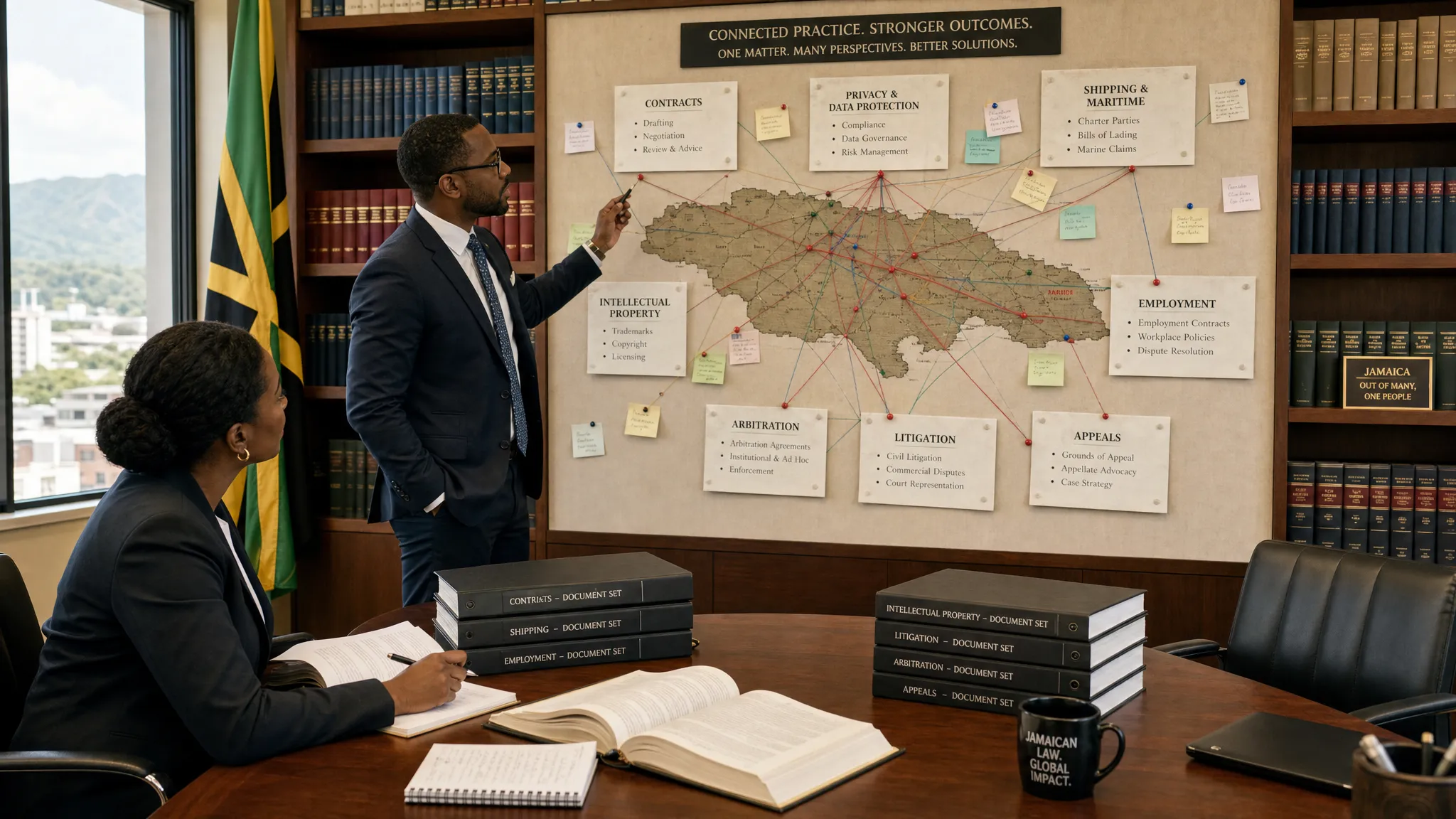
Legal issues rarely arrive with neat labels. A business owner may say, “A supplier broke our agreement.” A family may say, “We need to protect an estate asset.” A company may say, “We received a data request and are not sure what to do.” Each of these problems points to a different legal path, and sometimes to more than one.
That is why understanding the different practice areas of law is useful. A practice area is simply a category of legal work. It helps you identify the type of lawyer, strategy, documents and forum that may be relevant to your situation.
This guide explains common practice areas in plain English, with examples that are especially relevant to businesses and individuals in Jamaica.
What a practice area actually means
A legal practice area is the field in which an attorney focuses their knowledge and experience. Some practice areas are based on the subject matter, such as intellectual property, data privacy, employment or shipping. Others are based on the process, such as litigation, arbitration, mediation or appeals.
The same legal problem can involve several practice areas. For example, a dispute over a software contract may involve contract law, commercial litigation, intellectual property and data privacy. A shipping dispute may involve admiralty law, insurance, commercial contracts and litigation strategy.
In Jamaica, legal matters are shaped by statutes, the Constitution, court rules and common law principles. If you want a broader foundation, this overview of Jamaica’s legal system explains the court structure and common law roots in more detail.
A simple way to think about legal work
Before choosing a lawyer, it helps to identify what kind of legal work your issue requires. Most matters fall into one or more of these categories.
Type of legal work | What it means | Example |
Advisory work | Getting legal guidance before taking action | Asking whether a new business policy complies with the law |
Transactional work | Drafting, reviewing or negotiating documents | Preparing a contract, licence or settlement agreement |
Dispute work | Resolving conflict through negotiation, court, arbitration or mediation | Suing for breach of contract or defending a claim |
Regulatory work | Managing obligations imposed by laws or regulators | Data privacy compliance, competition law or financial sector rules |
Appellate work | Challenging or defending a decision after judgment | Appealing a court ruling or responding to an appeal |
This is important because the right lawyer is not only the one who knows the topic. The right lawyer also understands the process. A strong commercial lawyer may help draft an agreement, while a litigation attorney may be needed when that agreement becomes the subject of a dispute.
Common practice areas of law, explained simply
The list below is not exhaustive, but it covers many of the practice areas individuals, companies and institutions commonly encounter.
Practice area | Plain-English meaning | Common situations |
Civil litigation | Non-criminal disputes between people, companies or organisations | Contract claims, negligence claims, property disputes, debt recovery |
Commercial law | Legal issues affecting business operations | Business agreements, shareholder issues, supplier disputes, corporate risk |
Commercial litigation | Court disputes involving businesses or commercial transactions | Breach of contract, fraud claims, partnership disputes, injunctions |
Contract law | Creating, interpreting and enforcing agreements | Service contracts, leases, sale agreements, licensing arrangements |
Banking and finance law | Legal issues involving banks, lenders, borrowers or financial transactions | Loan disputes, security enforcement, banking litigation |
Data privacy | Protecting personal data and meeting privacy obligations | Privacy policies, data requests, breach response, compliance reviews |
Compliance and risk law | Helping organisations follow legal and regulatory requirements | Internal policies, risk assessments, governance procedures |
Intellectual property | Protecting creations, brands, inventions and confidential information | Trademarks, copyright, trade secrets, licensing disputes |
Competition law and policy | Rules that protect fair competition in the market | Anti-competitive conduct, merger concerns, market dominance issues |
Admiralty and shipping | Legal issues involving vessels, cargo, ports and maritime commerce | Cargo claims, vessel arrests, shipping contracts, marine insurance disputes |
Employment and labour law | Rights and obligations between employers and workers | Workplace policies, dismissals, contracts, employee disputes |
Real estate and property law | Legal issues involving land, buildings and ownership rights | Sales, leases, title issues, boundary disputes |
Family and probate law | Personal matters involving families, estates and succession | Divorce, custody, wills, estate administration |
Criminal law | Offences prosecuted by the state | Defence of criminal charges, bail, trial preparation |
Arbitration and mediation | Private or alternative ways to resolve disputes | Commercial arbitration, mediated settlements, dispute clauses |
Appellate law | Legal work after a decision has been made | Appeals, written submissions, challenging legal errors |
A useful distinction is that some areas describe the problem, while others describe the path to solving it. “Intellectual property” describes the subject matter. “Litigation” describes the process. A trademark dispute can therefore be both an intellectual property matter and a litigation matter.
How practice areas overlap in real life
Legal categories are helpful, but real life is often messier. A single matter may begin in one practice area and quickly expand into another.
A company that discovers a former employee using confidential business information may need employment law advice, intellectual property protection and urgent litigation strategy. A business responding to a data incident may need privacy compliance advice, contractual review and reputational risk management. A dispute over unpaid invoices may appear simple at first, but it can raise questions about contract terms, interest, evidence, limitation periods and enforcement.
This is why the first legal consultation often focuses on diagnosis. The lawyer’s job is to identify the real issue, not just the label the client uses. For example, many non-criminal disputes are civil matters, and this guide to civil matters for businesses and individuals explains that category more fully. If the matter is likely to move toward court, it may also help to understand what litigation attorneys do and when to hire one.

How to know which practice area you need
If you are not sure which category your issue falls into, start with the practical problem rather than the legal label. A good lawyer can help classify the matter, but you can make the first conversation more productive by thinking through the basics.
Ask yourself what outcome you need. Do you want advice before signing something? Do you need to stop someone from taking action? Are you trying to recover money? Do you need to defend a claim? Are you appealing a decision? The answer will often point toward advisory, transactional, litigation or appellate work.
You should also consider urgency. Some matters allow time for careful negotiation. Others may require immediate steps, such as preserving evidence, responding to a deadline or seeking urgent court relief.
A practical checklist can help:
Identify the main problem in one sentence.
Gather the key documents, such as contracts, letters, emails, policies, invoices or court papers.
Note any deadlines, hearing dates, response dates or limitation concerns.
List the people, companies or agencies involved.
Decide what result would solve the problem, or at least reduce the risk.
Ask whether the issue may involve more than one area of law.
If you want a broader view of the kinds of help attorneys can provide, this article on legal services attorneys can handle for you is a helpful next step.
Why specialisation matters
Law is not just about knowing rules. It is also about judgment, timing, evidence, negotiation and procedure. A lawyer who regularly works in a particular practice area is more likely to understand the risks that are not obvious at first glance.
For businesses, this can be especially important. A poorly drafted contract may create litigation risk years later. A weak compliance system may expose a company to regulatory scrutiny. Mishandled intellectual property may reduce the value of a brand. A delayed response to a lawsuit may affect available defences.
For individuals, the stakes can be just as serious. Property disputes, estate issues, employment conflicts and civil claims can affect finances, reputation and personal security. Choosing a lawyer with the right practice fit helps avoid wasted time and misdirected strategy.
Specialisation does not mean a lawyer only understands one narrow topic. Many experienced attorneys work across related areas. The key is whether the lawyer can recognise the legal, commercial and procedural dimensions of your matter.
Practice areas commonly needed by businesses
Businesses often need a mix of preventive and dispute-focused legal support. Preventive advice helps reduce risk before a problem becomes expensive. Dispute advice helps protect the business when conflict has already arisen.
Common business-facing practice areas include commercial law, commercial litigation, banking litigation, compliance and risk, data privacy, intellectual property, competition law, arbitration and mediation, and appellate work. Companies involved in trade, logistics, ports or marine operations may also need admiralty and shipping expertise.
A client-centric legal team will usually begin by understanding the business objective. The legal answer should support the commercial reality. For example, a company may not simply want to “win” a dispute. It may want to preserve a relationship, protect confidential information, recover a debt, avoid disruption or create leverage for settlement.
Practice areas commonly needed by individuals
Individuals may encounter legal issues through personal relationships, property, employment, business ownership, inheritance, consumer transactions or civil disputes. The relevant practice area depends on the right being affected and the remedy needed.
A claim for unpaid money may be civil litigation. A dispute about land may involve property law and court procedure. A workplace issue may require employment advice. A defamation claim may involve civil litigation and reputational considerations. An appeal from a judgment requires a different skill set from the original trial, because appellate work focuses heavily on legal error, written submissions and the record of proceedings.
The lesson is simple: do not assume the first label is the final answer. A matter that sounds straightforward may require a deeper legal assessment.
Frequently Asked Questions
What are the main different practice areas of law? Common practice areas include civil litigation, commercial law, contract law, intellectual property, data privacy, compliance, banking and finance, employment, property, family, criminal law, shipping, arbitration, mediation and appeals.
Can one legal matter involve several practice areas? Yes. A business dispute may involve contract law, commercial litigation, data privacy, intellectual property and regulatory compliance at the same time. The lawyer’s role is to identify the overlap and build a coherent strategy.
How do I know if I need a litigation attorney? You may need a litigation attorney if a dispute has escalated, court papers have been served, negotiations have failed, urgent relief is needed or you must defend a claim. Early advice can help preserve evidence and avoid procedural mistakes.
Is civil law the same as criminal law? No. Civil law usually deals with disputes between private parties, such as individuals or companies. Criminal law deals with offences prosecuted by the state. Some facts can create both civil and criminal issues, but the processes and consequences are different.
Do businesses need legal advice only when there is a dispute? No. Many of the most valuable legal services are preventive. Contract review, compliance planning, privacy policies, risk assessment and governance advice can help avoid disputes before they begin.
Need help identifying the right practice area?
Understanding the different practice areas of law is a good starting point, but every matter turns on its own facts, documents and deadlines. Henlin Gibson Henlin provides client-focused legal services across areas such as commercial litigation, data privacy, compliance and risk, intellectual property, admiralty and shipping, appellate matters, arbitration and mediation.
If you need guidance on which legal path fits your situation, contact Henlin Gibson Henlin for advice tailored to your circumstances.
This article is for general information only and does not constitute legal advice.