
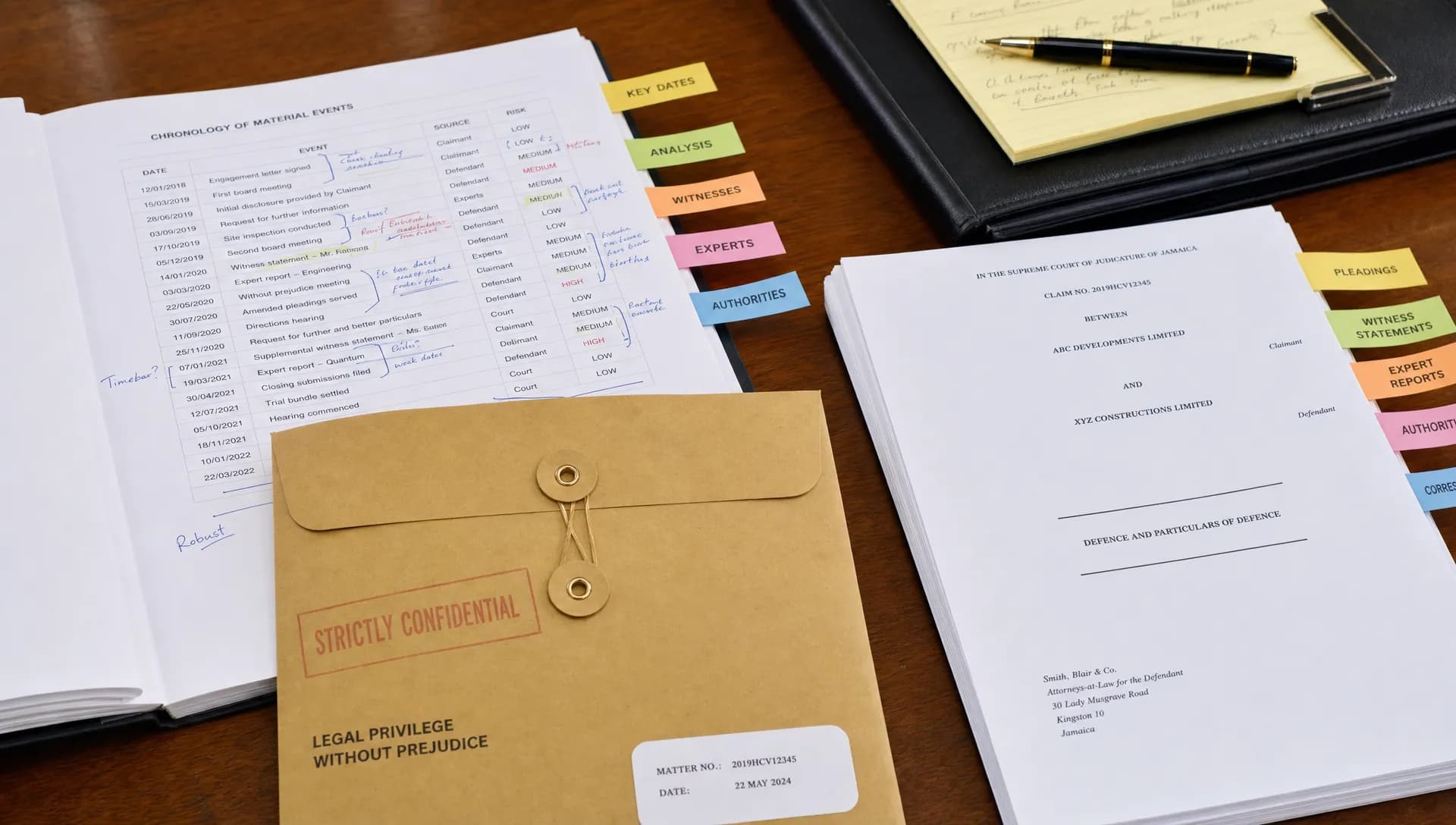
A high-stakes legal matter rarely turns on one brilliant argument. It is usually won, settled or contained through a series of disciplined decisions made under pressure. The facts may be incomplete, the commercial consequences may be immediate and the legal risks may cut across more than one practice area.
That is where the judgement of a senior partner in a law firm becomes especially valuable. The role is not simply to supervise junior lawyers or appear at important hearings. It is to bring structure to uncertainty, test assumptions before they harden into strategy and keep the client focused on the result that matters most.
In Jamaica and across cross-border matters, high-stakes disputes can involve commercial litigation, banking issues, regulatory exposure, data privacy concerns, intellectual property rights, shipping claims, urgent injunctions or appeal risk. Each matter has its own legal texture, but the senior partner’s function is broadly consistent: protect the client’s position while guiding the team toward a practical, defensible outcome.
What Makes a Legal Matter High-Stakes?
A case does not become high-stakes only because the claim value is large. The real measure is consequence. A dispute may threaten a company’s cash flow, licensing position, reputation, market access, key contracts or ability to continue operations. For an individual or family business, the stakes may be equally serious even when the numbers are smaller.
A high-stakes matter often has several of these features:
Urgent deadlines, such as injunction applications, freezing orders or regulatory responses
Sensitive documents, confidential information or privileged communications
Multiple parties with competing interests
Parallel risks, including litigation, compliance, media, commercial and reputational exposure
Technical evidence requiring specialist input
A realistic possibility of appeal, enforcement or cross-border consequences
The first task of a senior partner in a law firm is to recognize which risks are legal, which are commercial and which are strategic. Treating every issue as purely legal can lead to technically correct advice that misses the client’s broader objective.
Defining the Client’s Real Objective
At the start of a major matter, clients often describe their goal in simple terms: win the case, stop the other side, recover the money or avoid liability. Those goals may be valid, but they are rarely complete.
A senior partner tests the objective by asking what the client needs the legal process to achieve. In a commercial dispute, the true goal may be to preserve a banking relationship, protect a supply chain or create leverage for an orderly settlement. In an intellectual property matter, the goal may be to stop misuse quickly rather than litigate every possible claim. In a regulatory matter, the priority may be to show credible compliance and reduce future exposure.
This is why strategy begins before pleadings are drafted. The client’s real objective affects the forum, the tone of correspondence, the evidence to prioritize, the appetite for settlement and the level of publicity the matter can tolerate. For a deeper look at how this thinking develops, Henlin Gibson Henlin has also discussed how a law firm senior partner shapes case strategy in complex disputes.
The First Phase: Triage, Preservation and Risk Mapping
The early phase of a high-stakes matter can determine the quality of the entire case. A senior partner in a law firm will usually move quickly to stabilize the situation before the team commits to a full strategy.
That early triage includes identifying what must be done immediately and what should not be done yet. Sending an aggressive letter too soon, making public statements, contacting witnesses without a plan or disclosing sensitive documents can all create avoidable problems. At the same time, delay may cause evidence to disappear or weaken the client’s position.
A disciplined first review normally covers:
The key facts known so far
Documents that must be preserved
Potential causes of action or defences
Urgent procedural options
Limitation periods and court deadlines
Conflicts of interest and privilege issues
Regulatory, contractual or insurance notice obligations
Settlement possibilities and commercial pressure points
The senior partner’s value at this stage is not only legal knowledge. It is the ability to separate noise from genuine risk and to set priorities when everyone is moving quickly.
Early issue | Senior partner’s guiding question | Why it matters |
Evidence | What must be preserved immediately? | Lost evidence can weaken claims, defences and credibility. |
Urgency | Is court intervention needed now? | Some remedies depend on speed and clean conduct. |
Forum | Where should this dispute be handled? | Court, arbitration, mediation and negotiation each change the strategy. |
Exposure | What is the worst realistic outcome? | Clients need a practical risk range, not false certainty. |
Communications | Who may speak and what may be said? | Poor messaging can affect litigation, regulators and reputation. |
Building the Right Legal Team Around the Matter
High-stakes work is rarely a solo exercise. Even when one senior lawyer leads the strategy, a serious matter may require litigators, appellate counsel, compliance lawyers, intellectual property advisers, data privacy support, banking litigation experience or admiralty and shipping expertise.
The senior partner decides how the team should be structured. That means matching lawyers to the issues, defining responsibility clearly and making sure no critical point falls between practice areas. In a commercial dispute with a data privacy component, for example, the litigation team may need to coordinate with lawyers who understand personal data obligations. In a shipping dispute, procedural speed and industry knowledge may be just as important as the underlying claim.
Good team leadership also protects the client from duplication. A large team is not automatically a better team. The goal is to put the right people on the right tasks with a clear chain of accountability. Readers interested in the wider team dynamic may find it useful to review how Henlin Gibson Henlin describes the legal team behind complex case strategy.
Turning Facts Into a Workable Case Theory
Once the urgent issues are under control, the senior partner helps the team build a case theory. This is not a slogan or a courtroom theme. It is the disciplined explanation of what happened, why the law supports the client’s position and what remedy or outcome should follow.
A strong case theory must survive pressure. It should fit the documents, explain difficult facts and remain coherent if tested before a judge, arbitrator, mediator, regulator or opposing counsel. In high-stakes matters, the weakest part of the case often determines the negotiation leverage, so a senior partner will probe the uncomfortable points early.
This is where experience matters. A junior lawyer may identify every arguable issue. A senior partner in a law firm must decide which issues deserve attention, which should be abandoned and which may distract from the strongest path to resolution.

Managing Evidence, Experts and Procedural Pressure
Evidence management is one of the most important parts of guiding a high-stakes matter. Documents must be collected properly, witnesses must be prepared ethically and expert evidence must be aligned with the legal issues the court or tribunal will actually need to decide.
A senior partner will typically ask whether each piece of evidence advances the case theory. If it does not, the team must know why it is being used. More evidence is not always better. In complex litigation, excessive material can obscure the strongest points and increase cost without improving the client’s position.
Procedural pressure also requires senior oversight. Deadlines, filings, affidavits, applications, discovery obligations and hearing preparation must fit into a coherent timetable. Modern litigation rewards preparation and punishes drift. When the matter involves appeal risk, the record must also be built carefully from the start, because an appeal court will usually examine what was argued, preserved and decided below.
In urgent matters, senior guidance becomes even more direct. Applications for interim relief require speed, accuracy and credibility. A client seeking an injunction, for example, must be ready to present a clear factual record and address the court candidly. Strategic overreach can damage credibility at the very moment when credibility matters most.
Communication With the Client, Board and Stakeholders
A high-stakes matter can put intense pressure on decision-makers. Directors may need to brief a board. Executives may need to update lenders, insurers or regulators. A family business may need to manage personal relationships alongside legal exposure. The senior partner often becomes the person who translates legal complexity into decisions the client can actually make.
Clear advice does not mean simplistic advice. It means identifying options, consequences and recommended next steps without burying the client in every internal debate. The client should understand the risk, the cost, the timing and the likely reaction of the other side.
In practice, senior partner communication often includes:
A concise assessment of strengths and weaknesses
A realistic range of outcomes
A recommendation with reasons
A litigation or negotiation timetable
Warning points that may change the strategy
Guidance on confidentiality and external messaging
This communication role is especially important where legal strategy affects business operations. A decision to litigate aggressively may be correct in law but damaging commercially. A decision to settle may protect the business but create future precedent or reputational concerns. The senior partner’s job is to make those tradeoffs visible.
Settlement, Mediation and Litigation Readiness
High-stakes guidance is not measured by how long a case stays in court. In many matters, the best result is a negotiated outcome reached from a position of strength. Arbitration, mediation and direct settlement discussions can preserve confidentiality, reduce disruption and allow commercial solutions that a court may not be able to order.
But settlement strategy only works when the team is prepared to litigate if necessary. Opposing parties can often tell when a case has been prepared only for negotiation. A senior partner in a law firm keeps both tracks alive: readiness for hearing and openness to resolution.
This balance requires careful judgement. Settling too early may leave value on the table. Waiting too long may increase cost, harden positions and reduce commercial flexibility. The senior partner monitors when leverage is improving, when it is fading and when the client’s objectives would be better served by a controlled compromise.
Henlin Gibson Henlin’s discussion of how litigation practice groups handle complex claims offers useful context on how coordinated teams manage evidence, procedure and resolution planning.
Ethics, Professional Judgement and Reputation Protection
In high-stakes legal matters, pressure can tempt parties to move too quickly or too aggressively. Senior partners help prevent that pressure from compromising professional standards. Conflicts must be checked. Privilege must be protected. Communications must be accurate. Court obligations must be respected.
This is not a formality. Reputation can become part of the case. A client who appears evasive, careless with documents or unwilling to comply with procedure may weaken its own position. A legal team that maintains discipline and credibility gives the client a strategic advantage.
The senior partner also has a role in managing expectations. No responsible lawyer should guarantee an outcome. What the client deserves is a clear view of the path ahead, the risks attached to each option and the reasoning behind each recommendation.
How Senior Guidance Changes the Outcome
The work of a senior partner is often most visible at major hearings, settlement meetings or crisis moments. Yet much of the value appears earlier, in choices that prevent later damage. A well-timed preservation notice, a narrower pleading, a better expert question, a more careful board update or a decision not to send an inflammatory letter can materially change the direction of a matter.
A high-stakes legal matter needs more than activity. It needs judgement, sequencing and restraint. The senior partner in a law firm provides that guidance by keeping the legal team aligned with the client’s objectives, the evidence and the realistic pressures of the dispute.
For clients, the practical question is not whether a senior partner is involved in name. It is whether that partner is actively guiding strategy, testing risk, coordinating the team and helping the client make informed decisions at each stage.
Frequently Asked Questions
What does a senior partner do in a high-stakes legal matter? A senior partner guides strategy, assesses risk, supervises the legal team, helps manage client communications and ensures that legal steps support the client’s broader objective.
When should a senior partner become involved? Senior involvement is most valuable at the start of a high-stakes matter, especially where urgent deadlines, sensitive evidence, reputational risk or complex commercial issues are present.
Does senior partner involvement mean the matter will go to court? No. Senior guidance can support litigation, arbitration, mediation or settlement. The goal is to choose the process that best protects the client’s position.
Why is strategy important before filing a claim or defence? Early strategy affects evidence preservation, forum selection, pleadings, negotiation leverage and appeal risk. Mistakes made at the outset can be difficult to repair later.
How does a client know if a matter is high-stakes? A matter is high-stakes if the outcome could significantly affect finances, business operations, reputation, regulatory standing, ownership rights or future legal exposure.
Discuss a High-Stakes Matter With Experienced Counsel
When a legal issue carries serious commercial, regulatory or reputational consequences, early strategic guidance matters. Henlin Gibson Henlin advises clients across areas including commercial litigation, compliance and risk, data privacy, intellectual property, admiralty and shipping, arbitration, mediation and appellate matters.
If you need experienced legal support in Jamaica, you can learn more about Henlin Gibson Henlin’s client-focused legal services and consider seeking advice before urgent decisions narrow your options.