
Arranging legal assistance for an overseas dispute starts with three practical questions: which deadlines apply, where a lawyer must be authorised to act and where any settlement or judgment could be enforced. For a Jamaican business or individual, the right arrangement may involve Jamaican counsel, a lawyer in another country or both. Hiring someone simply because they are based near the other party is not always enough.
Your first objective is to establish a workable plan, not to commit immediately to full litigation. A focused initial instruction should identify urgent risks, the appropriate forum, likely costs and the information needed to decide what happens next.
1. Protect your position before choosing a strategy
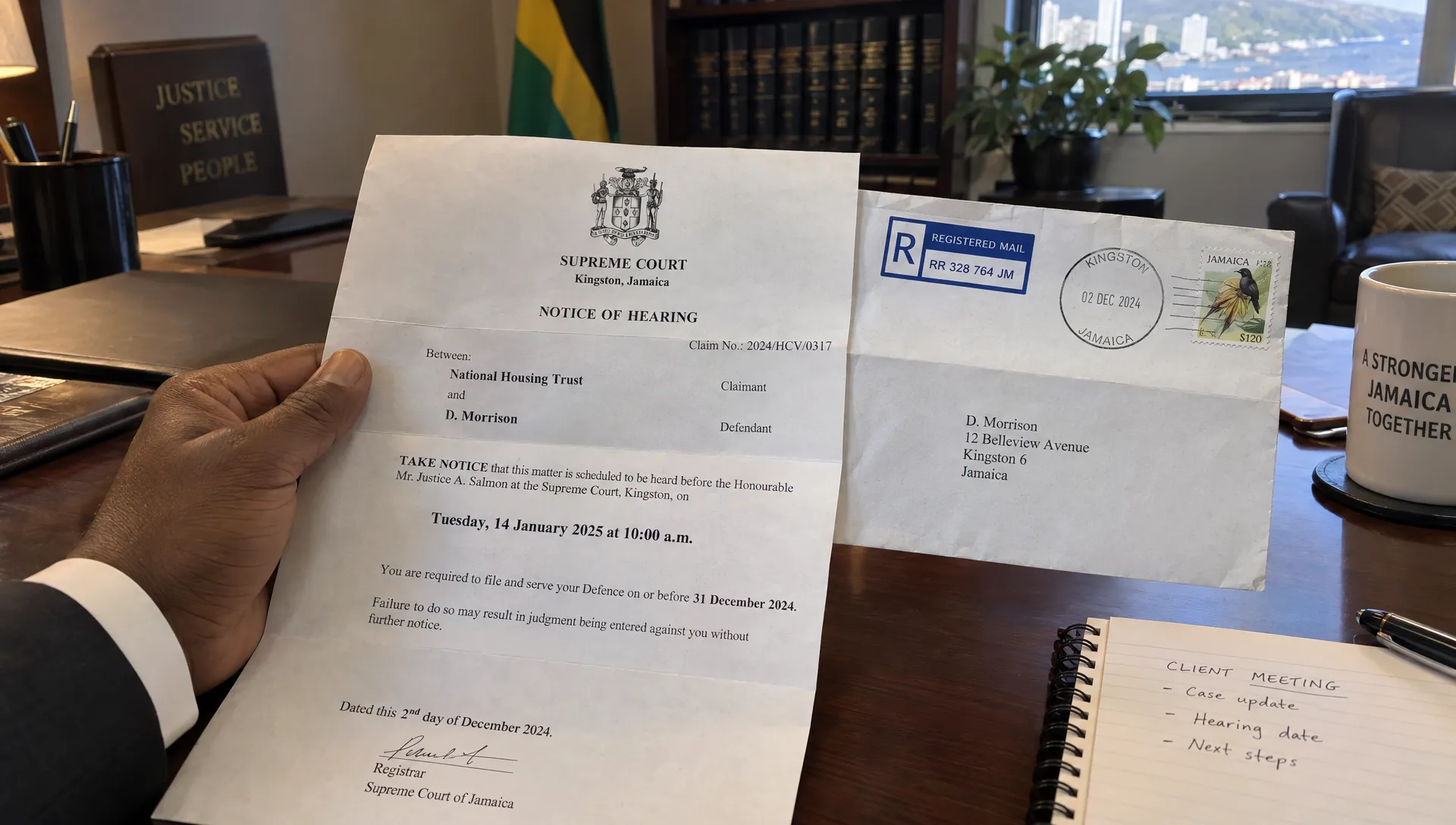
If you have received court papers, an arbitration notice or an order affecting assets, seek advice promptly. Record when and how the documents arrived, preserve the envelope or electronic delivery record and send the complete documents to counsel. A response period may run from an event you would not expect under Jamaican procedure.
Do not assume that a deadline is invalid because the papers came from abroad. Equally, do not admit liability or accept a court’s jurisdiction before obtaining advice about the consequences.
Urgent legal assistance should distinguish between steps that preserve your position and decisions that commit you to a particular route. Ask counsel to identify:
The earliest possible response, appeal or limitation deadline
Any immediate risk to assets, evidence or business operations
Whether a protective filing or application is required
Actions you should avoid until the position is assessed
Preserve relevant emails, messages, contracts and transaction records. Suspend routine deletion where necessary and do not alter documents to make the file easier to understand. Keep your explanations separate from the originals.
Negotiations do not necessarily suspend limitation periods or procedural deadlines. Any agreement intended to pause a deadline needs legal review.
2. Decide where legal assistance is needed
A dispute can involve several countries for different reasons. The contract may select one country’s law, require arbitration elsewhere and involve a defendant whose assets are in Jamaica. Those connections answer different questions.
Question | Why it affects your arrangements |
Which law governs the dispute? | Counsel may need advice from a lawyer qualified in that legal system. |
Which court or tribunal can hear it? | Local procedural knowledge and authorisation to act may be necessary. |
Where are witnesses and records located? | Evidence gathering, translation and data-transfer requirements may differ. |
Where are recoverable assets located? | Enforcement advice may be needed before substantial costs are incurred. |
Send counsel the entire contract, including schedules, incorporated terms and amendments. A dispute-resolution clause should not be assessed from a screenshot of one paragraph.
Effective legal assistance may require a lead lawyer supported by counsel in another jurisdiction. Ask who will advise on Jamaican law, who will handle the overseas proceedings and whether any additional specialist is necessary.
The division should follow the actual issues. A Jamaican lawyer’s familiarity with your business does not, by itself, authorise that lawyer to appear in a foreign court. Likewise, foreign counsel may need Jamaican advice about local assets, witnesses or obligations.
3. Verify counsel and clear conflicts early
Look for relevant dispute experience rather than relying solely on a firm’s size or international branding. A lawyer handling an overseas inheritance dispute needs different experience from one pursuing a shipping claim or defending a commercial arbitration.
For Jamaican attorneys, the General Legal Council is an appropriate starting point for professional verification. For overseas counsel, identify the relevant regulator or licensing authority and confirm current authorisation through an independent channel. A directory entry or persuasive website is not sufficient on its own.
Before sending sensitive details, provide the names of the parties, their relevant affiliates and anyone else needed for a conflict check. Explain that further documents will follow once the firm confirms whether it can consider the instruction.
When comparing legal assistance, ask who will actually handle the work, what comparable matters they have handled and whether they can meet the immediate deadline. Request an explanation of any local counsel, barrister, expert or translation support they expect to need.
Clarify the identity of the client as well. Where a company, director and shareholder are all involved, their interests may differ. One engagement should not be assumed to cover everyone, and some parties may require separate representation.
4. Prepare a focused evidence pack
A useful initial file lets counsel understand the dispute without reconstructing it from hundreds of disconnected messages. Start with a short chronology that identifies the parties, key events, sums involved and the outcome you want.
Keep the supporting material organised into a few clear groups:
Contract documents: Signed agreements, terms, amendments and dispute-resolution clauses
Performance records: Invoices, payment evidence, delivery documents and acceptance records
Communications: Relevant correspondence, notices and any settlement exchanges
Proceedings: Court papers, tribunal correspondence, orders and proof of delivery or service
For an overseas workwear purchase, for example, a catalogue such as Bestex Fabricage’s workwear range may help identify the advertised product specification. Your transaction file should also retain the actual order, agreed specifications and invoice identifying the contracting entity. A general product page does not establish all the terms of a particular purchase.
Well-organised records make legal assistance more efficient, but avoid presenting assumptions as established facts. Mark gaps in the chronology and explain which points the other party disputes.
Preserve original files and metadata where possible. Ask counsel how to transfer confidential material securely, especially records containing personal data. Copying a lawyer into correspondence does not automatically make existing business documents privileged, and privilege rules can differ between countries.
5. Agree the scope and costs in writing
Start with a defined task where possible. You might instruct counsel to review jurisdiction, advise on an urgent deadline or prepare an initial merits assessment before authorising full proceedings.
The engagement letter should identify the client, responsible lawyer, scope of work and applicable fee arrangements. It should also explain what is excluded and when further approval will be sought.
Engagement point | What to clarify before proceeding |
Professional fees | Charging basis, rates where relevant, billing currency and applicable taxes |
Advance payments | How funds are held, applied and accounted for |
External expenses | Court fees, local counsel, experts, translations and document delivery |
Budget control | Estimate assumptions, reporting intervals and approval thresholds |
Decision-making | Who may approve filings, offers, settlement and additional expenditure |
Ending the engagement | Notice requirements, outstanding fees and transfer of the file |
An estimate is not necessarily a fixed fee. Ask what could change it, such as a jurisdiction challenge, additional parties or an urgent application. Also ask about potential liability for the opposing party’s costs and whether security for costs could become an issue.
Discuss funding options without assuming that arrangements available in one country are lawful or offered in another. Before paying an advance, independently verify the firm’s payment details using a trusted contact method. Treat unexpected changes to bank instructions as a warning requiring verification.

6. Set rules for communication and authority
Where two firms are involved, unclear responsibility can create duplicated work or missed tasks. Agree who leads the matter, who communicates with the other party and who maintains the deadline calendar.
Ask for important advice in writing, particularly recommendations about jurisdiction, settlement and procedural steps. Telephone discussions are useful, but a short written record makes it easier to confirm decisions and instructions.
Your legal assistance arrangements should specify how often you receive updates, who covers absences and how urgent instructions will be handled across time zones. Identify one authorised contact within your organisation, while ensuring that person can obtain necessary internal approvals.
Counsel should know the limits of their settlement authority. Permission to negotiate does not necessarily mean permission to accept an offer, release claims or agree to confidentiality obligations.
For businesses, consider who may access the file internally. Circulating advice widely can create confidentiality risks and may affect privilege, depending on the applicable law. Use an agreed document-sharing method rather than forwarding the complete file through personal accounts.
If you require interpreters or translated advice, arrange this early. Ask whether translations are needed merely for understanding or must meet a court’s certification requirements. Those are different tasks with different costs.
7. Check enforcement before committing to proceedings
A favourable decision has limited practical value if it cannot be enforced against accessible assets. Ask counsel to assess the likely recovery route before substantial litigation expenditure, not only after judgment.
Identify the correct defendant and investigate asset location through lawful means. The entity named on an invoice may differ from a parent company, distributor or trading brand. A claim against one does not automatically provide access to another’s assets.
Where recovery may take place locally, understanding the options for enforcing a foreign judgment in Jamaica can help shape the initial strategy. Recognition is not automatic, and the available route depends on the judgment and applicable legal requirements. Arbitral awards require a separate analysis.
Practical legal assistance should also address how documents will be served abroad. Informal receipt by email does not necessarily satisfy the rules for valid service, even if the recipient knows about the claim.
Compare the likely recovery with the cost, time and commercial disruption involved. Negotiation or mediation may be sensible, but settlement terms still need to address payment, default and enforceability across borders. The cheapest opening step is not always the least expensive overall route.
8. Leave the first consultation with a written action plan
By the end of the initial assessment, you should know what must happen next and who is responsible. Ask counsel to separate confirmed conclusions from issues that still require foreign-law advice or further evidence.
A practical action plan should record the immediate deadlines, outstanding documents, next procedural step and budget for the next stage. It should also identify the assumptions behind the recommendation. For example, a strategy based on the defendant having assets in a particular country may change if that assumption proves wrong.
Review the plan when new evidence arrives or the other party takes a significant step. You do not need a complete forecast of the entire dispute before acting, but you do need enough information to authorise the next stage intelligently.
Keep copies of engagement letters, invoices, advice and instructions in one controlled file. This makes it easier to monitor costs, brief additional counsel if necessary and maintain continuity if the matter becomes prolonged.
Frequently asked questions
Can I arrange legal assistance without travelling overseas? Often, initial advice and document review can be arranged remotely. However, identity checks, signatures, evidence requirements or hearings may require additional formalities or attendance. Confirm these requirements with counsel rather than assuming the entire matter can be handled online.
Can a Jamaican attorney represent me in a foreign court? Not automatically. The foreign jurisdiction’s admission and procedural rules determine who may appear. Jamaican counsel may advise on Jamaican issues and work alongside a lawyer authorised to handle the overseas proceedings.
Is free help available for an overseas dispute? Availability depends on the country, type of case and eligibility rules. Do not assume Jamaican legal aid will fund foreign commercial proceedings. Our guide to finding legal aid in Jamaica explains local starting points, but overseas coverage must be checked separately.
What if I cannot afford full representation? Ask whether a limited initial engagement is appropriate, such as reviewing the claim, identifying deadlines or advising on settlement options. Confirm what counsel will not handle so that responsibility for filings and deadlines remains clear.
Discuss the Jamaican aspects of your overseas dispute
If your dispute has a Jamaican connection, contact Henlin Gibson Henlin to discuss the issues, available documents and urgent deadlines. Prepare the parties’ names for conflict checks, together with the contract and any court or tribunal papers. The initial discussion can help establish which Jamaican issues require advice and whether counsel in another jurisdiction is also needed.