
An online accusation can move from a review site to WhatsApp, Instagram, LinkedIn and local media before a management team has finished its first meeting. For a Jamaican company, a business defamation crisis online is not only a public relations problem. It can affect customer confidence, supplier relationships, credit arrangements, staff morale and litigation risk.
This guide explains how to respond quickly without making the situation worse. It is general information, not legal advice, and a business facing a serious allegation should get advice based on the exact words, platform, audience and commercial context.
First, separate reputational noise from possible defamation
Not every harsh review or angry post is defamation. Customers have consumer rights, employees may raise legitimate concerns and competitors can express opinions if they do so lawfully. The first task is to distinguish criticism from a false factual statement that may cause legal harm.
In broad terms, defamation involves a statement published to someone other than the subject, referring to the person or business, carrying a defamatory meaning and causing or being likely to cause reputational damage. Jamaican businesses should also consider the Defamation Act and common law principles, which can be reviewed through Jamaica’s official legislation portal.
A statement such as a restaurant gave slow service may be an opinion based on a customer’s experience. A statement that a company steals customer funds, falsifies invoices or sells unsafe goods is different if it is false and presented as fact.
What to do in the first 24 hours
The first day of a business defamation crisis online should be disciplined. The aim is to preserve evidence, control internal communication and avoid publishing a rushed reply that creates new legal exposure.
Priority | What to do | Why it matters |
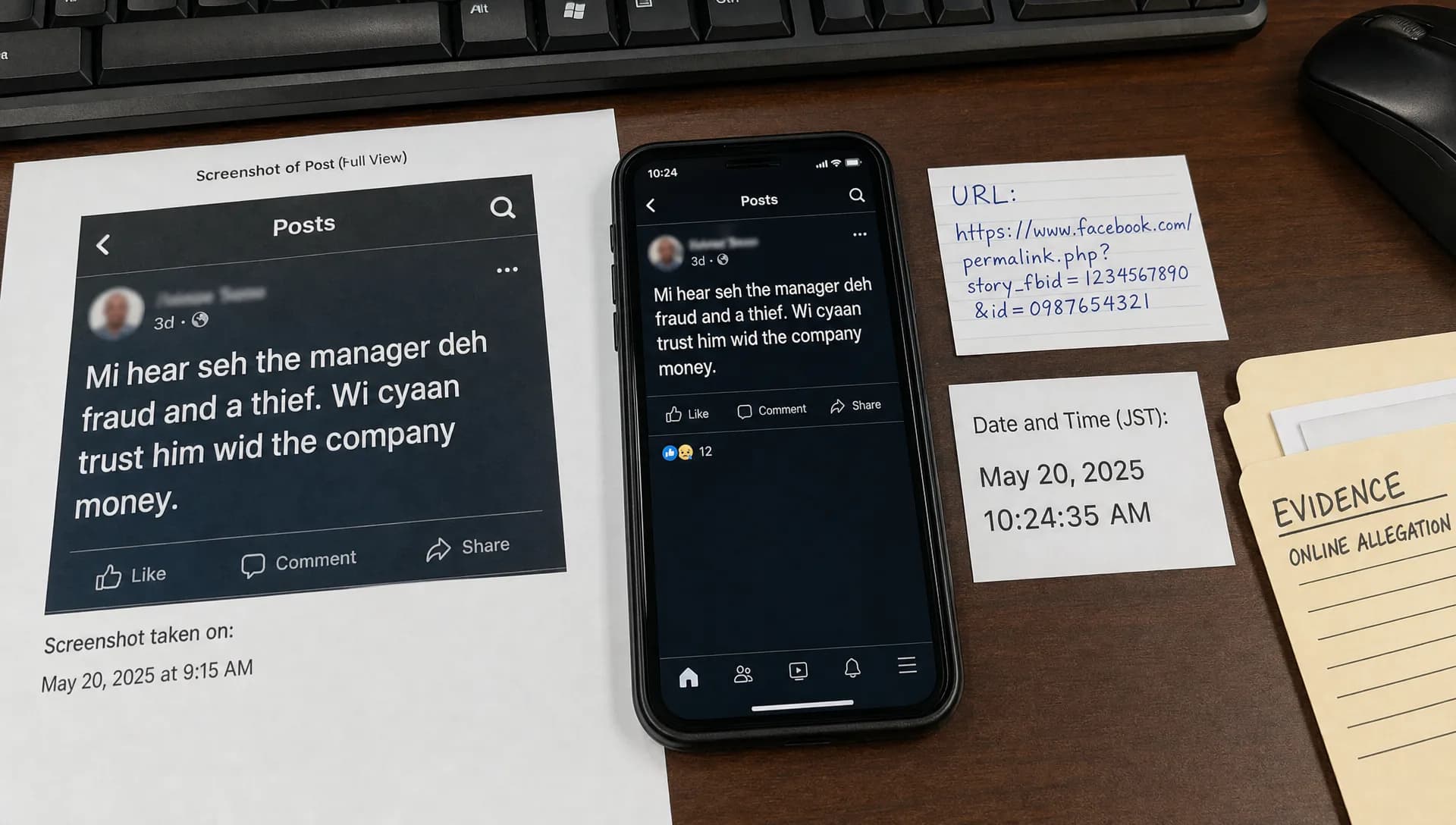
Capture the post | Save screenshots, URLs, dates, times and account details | Online content can be edited, deleted or reposted elsewhere |
Stop informal replies | Tell staff not to respond from personal accounts | Emotional responses can be used against the company |
Identify the allegation | Separate facts, opinions, insults and threats | Legal options depend on the exact meaning of the words |
Check business impact | Track lost orders, cancelled meetings and customer questions | Evidence of harm can matter if the dispute escalates |
Involve decision makers | Bring in leadership, communications staff and counsel | Defamation, data privacy and employment issues can overlap |
If the accusation is spreading rapidly, involves regulators, threatens legal action or alleges criminal conduct, the threshold for legal input is lower. Henlin Gibson Henlin’s guide on when to call in legal counsel during a business crisis is useful when deciding how quickly to escalate.
Preserve evidence before asking for removal
Businesses often want defamatory content removed immediately. That instinct is understandable, but removing or reporting content before it is properly preserved can weaken the company’s position. Ask a designated person to collect a clean evidence record before anyone contacts the poster or platform.
Useful evidence may include:
Full-page screenshots showing the post, profile name, date, time and surrounding comments
Direct links to the post, review, video, thread or repost
Copies of any direct messages, emails or calls connected to the allegation
Records showing business impact, such as cancellations, refund requests or supplier concerns
Internal records that show whether the allegation is false or misleading
Do not create fake accounts, threaten the poster privately or attempt to access private systems. Those steps can create new claims, undermine credibility and distract from the original defamation issue.
Why a business defamation crisis online needs legal triage
A business defamation crisis online can trigger several areas of law at once. The same post might contain a defamatory allegation, expose customer data, breach a confidentiality clause, infringe intellectual property or form part of an employment dispute. A narrow public relations response may miss the legal risks underneath.
Look at the exact words
The legal assessment starts with the wording. Counsel will usually ask what the post says, what an ordinary reader would understand it to mean, whether the statement is presented as fact or opinion and whether it identifies the business clearly.
Context matters. A sarcastic meme, a one-star review, a video caption and a detailed LinkedIn post may all communicate meaning differently. Reposts and comments also matter because they can expand the audience and change the overall impression.
Identify the speaker and motive
The poster may be a customer, ex-employee, competitor, supplier, shareholder, anonymous account or activist group. Each category changes the risk profile.
An ex-employee may raise employment law, confidentiality and whistleblowing questions. A competitor’s false claim may raise competition, passing off or malicious falsehood concerns. A customer complaint may require sensitivity because aggressive legal threats against genuine consumers can damage trust.
Check related regulatory and data issues
If the post includes customer records, employee files, payment information or screenshots from internal systems, treat the matter as more than defamation. Jamaica’s Data Protection Act, 2020 may be relevant if personal data has been exposed or mishandled.
Where a reputational incident also suggests a cyber incident or personal data exposure, the company should follow a structured response. The firm’s guide to data breach response steps every Jamaica company needs explains the kind of containment and documentation issues that may arise.
Decide whether to reply publicly
A public reply can calm the market, but it can also amplify the allegation. The safest response depends on whether the post is gaining traction, whether customers are asking questions and whether the business can respond without disclosing confidential information.
A good holding statement is usually short, factual and restrained. It should avoid repeating the defamatory allegation in full unless repetition is necessary. It should not attack the poster personally, speculate about motives or promise legal action before the company has decided on a strategy.
Situation | Possible response approach |
Low visibility complaint with some truth | Respond politely, correct what is inaccurate and move the discussion offline |
False allegation spreading quickly | Issue a measured statement denying the allegation and confirming review of legal options |
Anonymous defamatory post | Preserve evidence, report to the platform and avoid engaging in comment threads |
Allegation involving customer data | Coordinate legal, data privacy and communications response before speaking publicly |
Media inquiry | Prepare a consistent statement and designate one spokesperson |

Use platform tools strategically
Most platforms have reporting mechanisms for impersonation, fake reviews, harassment, confidential information and unlawful content. These tools can help reduce visibility, but they are not a substitute for legal action where the harm is serious.
For example, businesses can use Google Business Profile Help to request review removal where content violates Google’s policies. Similar reporting routes exist across major social media platforms. Keep records of each report, including submission dates, reference numbers and platform responses.
Avoid mass-reporting campaigns by employees or friends. Platforms may treat coordinated reporting as abusive and the tactic can look heavy-handed if the dispute later becomes public.
When to send a legal demand
A legal demand may be appropriate where the statement is clearly false, commercially damaging and unlikely to be resolved through a calm informal request. A strong demand letter usually identifies the defamatory statement, explains why it is false, requests removal or correction and reserves the business’s rights.
The tone matters. Overbroad threats can inflame the dispute, especially if the poster has a genuine complaint. A carefully drafted letter should focus on verifiable inaccuracies and desired remedies, such as removal, a correction, an undertaking not to repeat the allegation or compensation where appropriate.
When court action may be necessary
Court action may be considered where the content continues to spread, the poster refuses to remove it, the allegation threatens major contracts or the business needs urgent relief. Depending on the circumstances, remedies may include damages, injunctions, orders requiring removal or orders connected to identifying an anonymous wrongdoer.
Litigation is not always the fastest or most cost-effective route. It can also draw more attention to the allegation if not managed carefully. That is why early strategy is so important in a business defamation crisis online.
Manage staff, customers and partners calmly
Internal communication is often overlooked. Staff may see the post before management does and may feel tempted to defend the business online. Send a short internal instruction that no one should comment publicly, share the post or message the poster unless authorised.
Customer-facing teams need a clear script. They should know what they can say, what they must not say and who should handle escalations. If the allegation involves customer service, refunds, warranties or advertising, review whether there is a consumer law issue beneath the complaint.
Business partners, lenders, insurers and key suppliers may need a private briefing if the allegation could affect confidence. Keep those briefings factual. If the company is still investigating, say so. Overstating certainty too early can create problems if new facts emerge.
Watch for commercial litigation risk
Online defamation rarely happens in isolation. It may arise during a contract dispute, shareholder disagreement, unpaid invoice dispute, failed supply relationship or employee termination. If there is already a commercial conflict, the defamatory content may be one part of a wider legal strategy.
For Jamaican companies, the legal response should fit the wider dispute. A demand for removal may be sensible, but the company may also need to protect documents, review contracts, assess damages and prepare for a claim or counterclaim. Henlin Gibson Henlin’s article on commercial litigation risks Jamaican businesses should watch sets out several related risks that can surface when business relationships break down.
If there is a live dispute, avoid publishing statements that comment on negotiations, court proceedings or confidential contract terms. The online response should not prejudice the company’s litigation position.
Common mistakes that make the crisis worse
A business under pressure may act quickly but not wisely. The following mistakes are common in online defamation incidents:
Replying from personal accounts instead of using an approved company channel
Repeating the false allegation so often that more people see it
Threatening every critic instead of focusing on false factual claims
Ignoring legitimate customer concerns that sit beside the false statement
Deleting internal messages after the crisis begins
Publishing confidential customer, employee or supplier information in self-defence
Waiting too long to involve counsel when contracts, regulators or data privacy are involved
The goal is not to silence every negative comment. The goal is to correct falsehoods, protect reputation, preserve legal rights and keep the business credible.
Build an online defamation response plan before you need it
A response plan makes the first hour less chaotic. It does not need to be complicated, but it should identify who monitors online mentions, who captures evidence, who approves public statements and who contacts legal counsel.
The plan should also connect with existing policies. Employment contracts may address confidential information and social media conduct. Customer service protocols may set out how complaints are escalated. Data protection policies may require incident reporting if personal data is involved. Marketing teams should know how to handle fake reviews and impersonation accounts.
The strongest plans are practical. They include current contact details, platform login access, template holding statements and a simple evidence checklist. They also make clear that only authorised people may speak for the company during a reputational incident.
Frequently Asked Questions
Can a company sue for defamation in Jamaica? In general, a company may bring a defamation claim where a false published statement identifies the company and harms its reputation or business interests. The specific prospects depend on the words used, available defences, evidence of harm and the surrounding facts.
Should we respond publicly to a defamatory post? Sometimes, but not always. A short factual response may help if customers are concerned, but direct engagement can amplify the allegation. Preserve evidence and assess legal risk before publishing a detailed reply.
Can we force a platform to remove defamatory content? Platforms may remove content that violates their policies, but they do not decide every legal dispute. Serious cases may require a formal legal demand or court action, especially where the poster refuses to remove false statements.
What if the poster is anonymous? Preserve the account details, URLs and timestamps. Depending on the seriousness of the harm and the platform involved, legal options may include seeking disclosure through appropriate channels. Do not try to identify the person through unlawful access or intimidation.
Is a negative review defamation? A negative review is not automatically defamatory. Honest opinion, true statements and fair complaints may be lawful. The risk increases when the review states false facts that damage the business, such as accusations of fraud, criminal conduct or professional dishonesty.
When should a business involve legal counsel? Involve counsel early if the allegation is false and serious, spreading quickly, tied to a contract dispute, made by an employee or competitor, connected to personal data or likely to affect major customers, lenders or regulators.
Speak with a Jamaican legal team before the crisis hardens
Online defamation moves quickly, but a rushed response can do lasting damage. If your business is facing false allegations, impersonation, damaging reviews or a coordinated online attack, get advice before sending threats, posting a long denial or deleting records.
Henlin Gibson Henlin provides client-focused legal services in Jamaica across areas including commercial litigation, data privacy, compliance, intellectual property, arbitration and appellate work. A measured legal strategy can help your business protect its reputation while keeping sight of the commercial relationship, regulatory risk and long-term dispute position.