
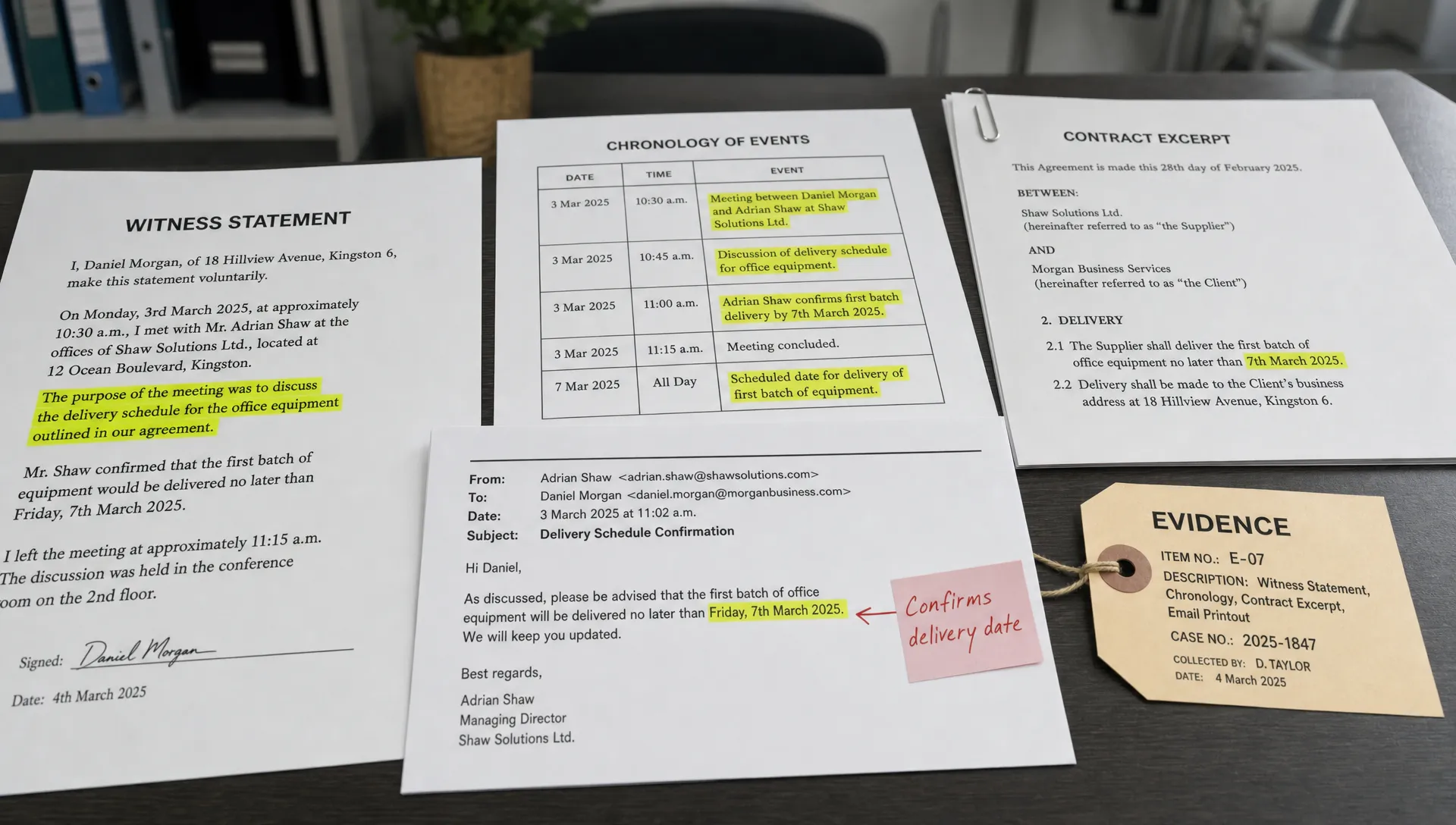
In a commercial court case, documents often carry the weight of the claim. Contracts, emails, invoices, board minutes and banking records can show what happened. Witnesses explain why it happened, how the parties understood it and whether the paper trail tells the full story.
That makes witness management a core part of commercial litigation, not a side task left until trial is approaching. A strong witness may clarify a complex transaction, support the credibility of the business and help the court understand the commercial context. A poorly managed witness can create contradictions, miss deadlines, disclose sensitive information or weaken an otherwise good claim.
For Jamaican businesses, directors, in-house counsel and commercial teams, the goal is simple: identify the right witnesses early, preserve accurate accounts and prepare them for court without coaching them or distorting their evidence.
What witness management means in a commercial dispute
Witness management is the process of finding, assessing, preparing and coordinating the people whose evidence may matter to the court. It begins long before a witness statement is filed. In many commercial disputes, it should begin as soon as a claim is threatened or a serious dispute is identified.
Good witness management usually covers four questions:
Who has direct knowledge of the relevant events?
What can each person prove from their own recollection or records?
How does their account fit with the documents and the legal issues?
What practical steps are needed to secure their cooperation and attendance?
The process is especially important in commercial litigation because business disputes often involve layered decision-making. The person who signed the contract may not be the person who negotiated it. The finance team may know about payment history but not performance issues. A former employee may know more about a failed transaction than any current manager.
If the witness picture is not mapped early, the case theory may be built around assumptions rather than evidence.
Start with the issues, not the personalities
A common mistake is to begin with the most senior people in the business and assume they will be the main witnesses. Seniority does not make a witness useful. The better starting point is the list of issues the court will need to decide.
In a breach of contract claim, those issues may include whether there was a binding agreement, what the parties understood the terms to mean, whether performance was defective and what loss was caused. In a shareholder dispute, the issues may involve authority, disclosure, good faith, valuation or oppressive conduct. In a banking litigation matter, the court may need evidence about facility letters, security documents, instructions, defaults and enforcement steps.
Once the issues are clear, match each issue to the people who can give first-hand evidence. This keeps the case focused and avoids calling witnesses whose evidence adds length but not value.
Witness category | Typical relevance in a commercial case | Main management risk |
Negotiators | Pre-contract discussions, commercial context and disputed representations | Memory may conflict with emails or draft agreements |
Contract signatories | Authority, execution and understanding of key terms | May have limited knowledge of implementation |
Operations staff | Delivery, performance, defects, delays and service failures | May not appreciate which details are legally relevant |
Finance staff | Invoices, payments, credit terms, loss and account records | Evidence may depend heavily on documents |
Former employees | Historic facts unavailable from current staff | Availability, loyalty and confidentiality concerns |
Expert witnesses | Technical, valuation, accounting or industry issues | Must remain independent, not an advocate for the party |
This issue-led approach also helps counsel decide whether a witness is necessary at all. Too many witnesses can blur the case. Too few can leave gaps that opposing counsel will exploit.
Assess each witness before relying on them
Not every helpful-sounding witness is a good witness. Before a business relies on a person’s evidence, the legal team should test both the content of the evidence and the reliability of the witness.
The most useful assessment is practical. Does the witness have direct knowledge or are they repeating what someone else told them? Are they able to explain dates, decisions and communications clearly? Does their account match the documents? Do they have a personal interest in the outcome? Are there past emails, minutes or messages that contradict their current recollection?
This assessment should be careful but fair. Commercial disputes often involve stressful events, large sums and damaged business relationships. People may remember events differently without being dishonest. The task is to separate honest uncertainty from evidence that cannot safely be advanced.
It is also worth checking availability early. A witness who has left Jamaica, changed employment or moved into a sensitive role may still be useful, but the legal team will need more time to address logistics. Where a witness may need to give evidence by video-link, the issue should be raised early enough for appropriate court directions. Henlin Gibson Henlin has previously discussed how Jamaica’s procedural framework has accommodated evidence being taken by video-link, a point that can become relevant when a key commercial witness is overseas or otherwise unable to attend in person.
Capture accounts while memories are still fresh
Witness evidence becomes harder to manage when interviews are delayed. Commercial teams move on, documents are archived, employees resign and the details of meetings begin to merge. Early witness interviews help preserve what people actually remember before their recollection is influenced by later disputes.
A careful interview should not be a rehearsal. It should be a structured effort to obtain the witness’s own account. Counsel will usually want to understand what the witness saw, heard, did and understood at the time. The interviewer should also identify the documents the witness created, received or relied on.
A useful first interview often covers:
The witness’s role during the relevant period
The key events they personally participated in
The documents, calls, meetings or messages they remember
Any uncertainty, missing information or contradictions
Other people who may have better knowledge of specific points
Interview notes should be handled with care. Depending on the circumstances, communications with lawyers may attract privilege, but privilege is not automatic for every document a business creates after a dispute arises. Businesses should take advice before circulating internal summaries widely, especially where sensitive commercial information, employee matters or regulated data is involved.
This is also where document discipline matters. Witness evidence is strongest when it is tested against a well-organised record. For a related practical framework, see the firm’s guidance on building a better evidence file for court, which explains how to organise documents by issue and chronology.
Prepare witness statements with precision
In civil and commercial proceedings, witness statements are often central to how evidence is presented. A witness statement is not a marketing document for the business. It should set out the evidence the witness can properly give in a clear, accurate and organised way.
The statement should be built around the legal issues and supported by the documents, but it must remain the witness’s evidence. Language that sounds too polished, argumentative or identical across multiple witnesses can damage credibility. A court is usually more assisted by a precise factual account than by broad statements that a party acted “unfairly” or “in bad faith” without explaining the events.
Good witness statements in commercial cases tend to share several qualities. They are chronological where that helps comprehension. They distinguish between what the witness personally knows and what they learned from records. They identify key documents without overloading the statement with every exhibit. They acknowledge uncertainty where memory is limited. They do not avoid difficult facts, because those facts are likely to surface in cross-examination.
Where multiple witnesses are giving evidence for the same party, their statements should be consistent where the facts genuinely align, but not artificially uniform. Real witnesses remember different details because they occupied different roles. That difference can make the evidence more credible, provided the accounts do not conflict on material points.
Prepare witnesses without coaching them
Witness preparation is legitimate. Witness coaching is dangerous.
The distinction matters. A lawyer may explain the court process, review the witness’s statement and documents with them, help them understand cross-examination and remind them of the need to answer truthfully. A lawyer must not tell a witness what to say, encourage them to hide uncertainty or shape their evidence to fit a preferred version of events.
Commercial witnesses often need preparation because they are not used to litigation. A director may be comfortable in a boardroom but unfamiliar with giving evidence under pressure. A finance officer may know the accounts well but become defensive when challenged on missing records. A technical employee may answer in jargon that obscures the point.
Preparation should help witnesses communicate honestly and clearly. They should understand that it is acceptable to say “I do not remember” if that is true. They should listen to the question, answer only the question asked and avoid guessing. They should also know that cross-examination is designed to test evidence, not to provide a comfortable conversation.

Manage corporate witnesses carefully
Commercial court cases often involve companies, partnerships, banks, insurers or other organisations rather than individuals acting in a personal capacity. That creates special witness management issues.
A company can only tell its story through people. The legal team must decide which individuals can explain the company’s actions and records. Current officers may speak to present business practices, but they may not know historic facts. Former employees may hold crucial knowledge, but they may now work for a competitor or have their own grievance against the company.
Internal coordination should be controlled. It is usually unhelpful for witnesses to discuss their evidence freely among themselves, especially after statements are being prepared. That can create allegations that accounts were aligned or influenced. Communications should be channelled through the legal team where possible.
Confidentiality is another concern. Commercial cases may involve customer data, trade secrets, pricing models, board discussions, intellectual property, regulatory reports or sensitive banking information. Witnesses should understand what they may review, what they may keep and what they must not forward to personal email accounts or third parties. Where personal data is involved, data protection obligations may also shape how documents are collected, stored and shared.
Do not ignore reluctant or adverse witnesses
Some of the most important witnesses in a commercial case are not enthusiastic. They may be former employees, counterparties, consultants, minority shareholders or professionals who were involved in the transaction. A reluctant witness may still have evidence that supports the case, but the approach must be strategic and legally sound.
Before contacting a reluctant witness, counsel should consider whether there are ethical, confidentiality or representation issues. If the person is connected to the opposing party, extra care is needed. If they are a former employee, the business should avoid asking them to misuse confidential information from a new employer or breach obligations owed elsewhere.
Where a witness has relevant evidence but will not cooperate voluntarily, the court process may provide mechanisms to compel attendance or production of evidence, subject to the applicable rules and court directions. Those steps should not be left until the eve of trial. They may require applications, service arrangements and enough time for objections to be addressed.
Adverse witnesses also need careful analysis. Sometimes a witness who appears harmful may be neutralised by documents. In other cases, their evidence may expose a weakness that should influence settlement strategy. The worst approach is to pretend the witness does not exist.
Coordinate expert evidence separately from fact evidence
Expert witnesses require a different management approach. A fact witness tells the court what happened. An expert assists the court on matters within specialised knowledge, such as accounting, valuation, engineering, technology, maritime practice or industry standards.
The expert’s role is independent. They are not there to argue the client’s case. If expert evidence is needed, the legal team should define the question carefully, provide the expert with the right materials and avoid pressuring the expert toward a convenient conclusion.
Commercial disputes can go wrong when expert instructions are too broad or too late. For example, a loss calculation may depend on documents that finance teams have not properly gathered. A technical opinion may require inspection before equipment is altered or disposed of. A valuation may depend on assumptions that counsel has not tested.
Managing experts well means aligning legal issues, factual records and specialist analysis. This should happen early enough to affect pleadings, disclosure, settlement evaluation and trial preparation.
Build a witness timeline for the whole case
Witness management is easier when it is treated as a timeline rather than a one-time task. The timeline should follow the procedural life of the case, from early assessment through trial.
Stage | Witness management focus | Common risk if delayed |
Pre-action or early dispute | Identify key witnesses and preserve initial accounts | Witnesses leave, memories fade or documents disappear |
Pleadings | Match witnesses to the factual allegations and defences | Case theory is pleaded without evidential support |
Disclosure | Test witness accounts against documents exchanged | Contradictions are discovered too late |
Witness statements | Prepare accurate statements in line with court directions | Deadlines are missed or statements become unfocused |
Pre-trial review | Confirm attendance, logistics and any special arrangements | Key witness becomes unavailable without a backup plan |
Trial | Coordinate attendance and manage witness order | Evidence is disrupted or witnesses are exposed to avoidable stress |
A structured timeline also helps the business budget properly. Witness management can involve interviews, document review, translation, travel, technology, expert engagement and applications to the court. These costs are easier to control when planned early.
For businesses that want to understand how witness work fits within the wider litigation process, the firm’s article on how civil litigation teams prepare strong cases gives a broader view of issue framing, procedural planning and evidence management.
Prepare for trial logistics, not just testimony
Even strong evidence can be undermined by poor logistics. Commercial trials often involve busy professionals whose calendars are difficult to control. Some witnesses may need to travel. Others may have confidentiality constraints, health concerns or work commitments that require early planning.
Trial preparation should confirm the order in which witnesses are likely to be called, whether they need to be present for the whole trial or only for their evidence, what documents they may review and how they should handle communications during the trial period. Witnesses should know where to attend, when to arrive and whom to contact if an issue arises.
Remote evidence requires its own checklist. The witness needs a suitable location, reliable internet, access to the relevant bundle and a clear understanding of the court’s expectations. No one should be prompting them off camera. Documents should be managed so the witness, counsel and court are looking at the same material.
If the case involves sensitive commercial information, the legal team should also consider whether any confidentiality measures or court directions are needed. These issues should be raised in advance, not during the witness’s evidence.
Handle inconsistencies before the other side does
Contradictions are common in commercial cases. A witness statement may not match an email. A director’s recollection may differ from board minutes. A finance witness may discover that the accounting records do not support an earlier assumption.
The answer is not to hide the inconsistency. The answer is to understand it. Sometimes the document is incomplete. Sometimes the witness is mistaken. Sometimes the apparent contradiction disappears when the sequence of events is properly explained.
Counsel should identify these issues during preparation and decide how they affect the case. A witness who can fairly explain a difficult document may still be valuable. A witness whose account collapses under document review may need to be reconsidered. This is one reason witness management and evidence management should never operate in separate silos.
Early recognition of weak points can also improve settlement decisions. A commercial case is not won by believing only the best version of the facts. It is managed well when the client understands both the strengths and the vulnerabilities before trial.
Protect witness credibility throughout the case
Credibility is built before the witness enters the courtroom. It is shaped by the accuracy of the statement, the consistency of the documents, the witness’s conduct and the fairness of the preparation process.
Businesses should avoid conduct that could later be characterised as pressure. Witnesses should not be threatened, rewarded for favourable evidence or encouraged to withhold information. Internal messages about witnesses should be written with care, because they may become relevant if privilege does not apply or is challenged.
A credible witness does not need to be perfect. Commercial life is messy, and courts understand that businesspeople may make mistakes. What damages credibility is evasion, exaggeration and unwillingness to accept clear documents. A witness who gives measured evidence, accepts what they do not know and explains what they do know is often more persuasive than a witness who tries to win every point.
Frequently Asked Questions
When should witness management begin in a commercial court case? It should begin as soon as litigation is reasonably anticipated. Early action helps preserve recollection, identify missing documents and avoid relying on witnesses who later prove unavailable or unreliable.
Can a lawyer prepare a witness before trial? Yes. A lawyer may explain the court process, review the witness’s statement and documents, and help the witness understand how to answer questions clearly and truthfully. The lawyer must not coach the witness to give false, exaggerated or scripted evidence.
What makes a good witness in a commercial dispute? A good witness has direct knowledge of relevant events, can explain those events clearly, is consistent with the documents and remains honest about what they do not remember. Credibility is usually more valuable than confidence.
Should every employee involved in the dispute give evidence? No. The court usually needs evidence that helps decide the issues. Calling unnecessary witnesses can increase cost, lengthen the trial and distract from the strongest parts of the case.
What if a key witness is overseas? The legal team should address this early. Depending on the circumstances and court directions, evidence by video-link or other arrangements may be considered, but practical and procedural requirements must be planned in advance.
Need help managing witnesses in a commercial dispute?
Witness evidence can shape the outcome of a commercial court case, but it must be handled with discipline, care and procedural awareness. The right approach protects credibility, reduces surprises and helps the court understand the business reality behind the documents.
Henlin Gibson Henlin advises clients across commercial litigation, banking disputes, arbitration, intellectual property, data privacy, compliance and related areas of Jamaican law. If your business is preparing for a commercial claim or responding to one, speak with an experienced litigation team before witness issues become trial problems.