
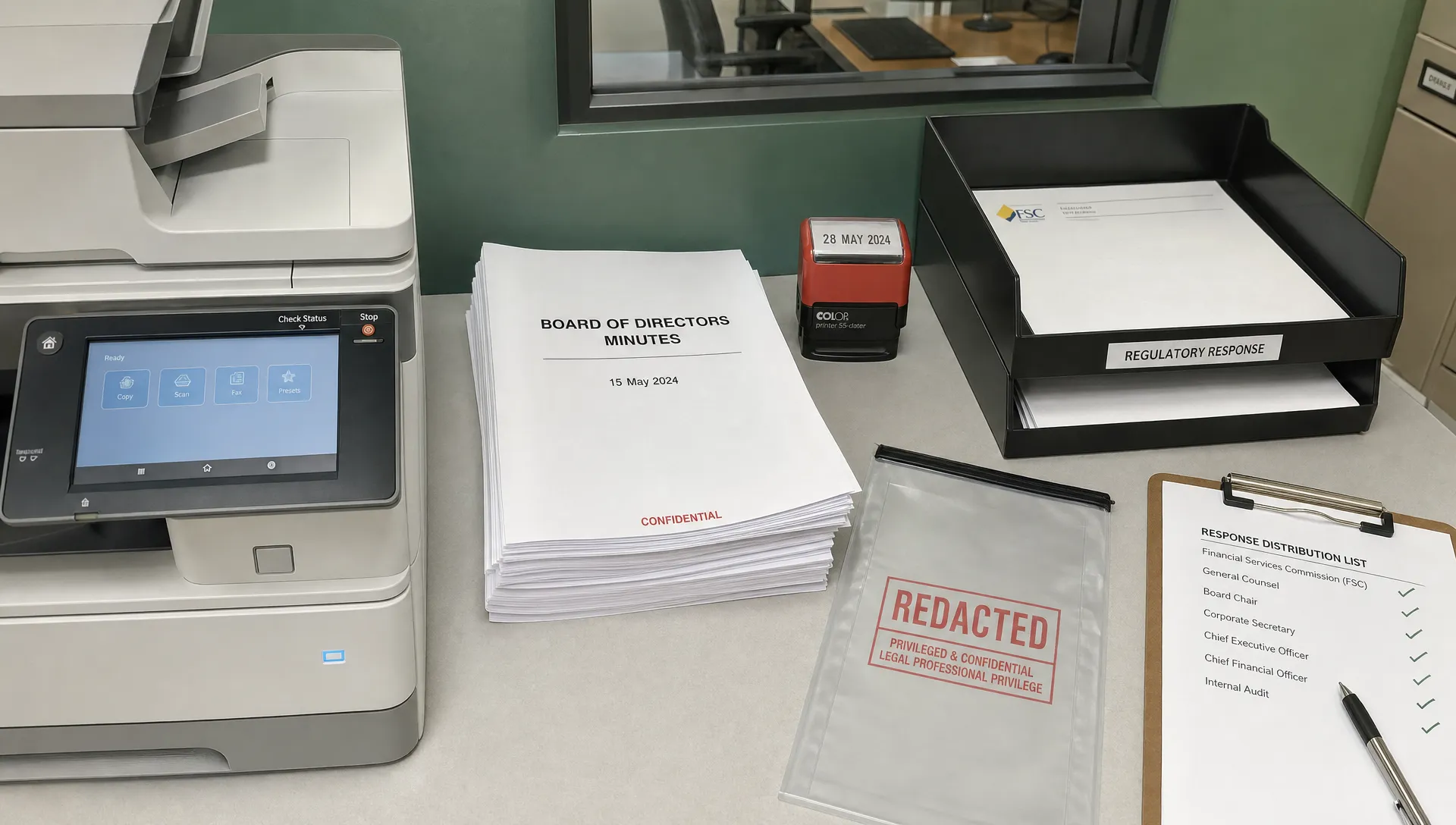
Receiving a notice, request for information or unannounced visit from a regulator is not the time to decide who owns compliance, where records are kept or who may speak for the business. A regulatory investigation can affect legal risk, licences, customer trust, employee relations and commercial negotiations at the same time, so preparation needs to be practical, documented and led by people with clear authority.
For Jamaican businesses, the relevant regulator may be sector-specific, such as the Bank of Jamaica, the Financial Services Commission, the Fair Trading Commission, the Office of the Information Commissioner, Tax Administration Jamaica, Jamaica Customs Agency or another public authority. The details vary, but the core discipline is the same: preserve evidence, understand the legal basis of the request, control communications and respond accurately.
What a regulatory investigation usually involves
A regulatory investigation is a formal or informal inquiry by a public authority into whether a person or organisation has complied with the law, licence conditions, statutory duties or regulatory guidance. It may start with a complaint, whistleblower report, routine audit, data breach, suspicious transaction, competitor allegation, media report or referral from another agency.
The first contact may look routine, but businesses should treat it seriously. A short email asking for records can later become an enforcement process if the response is incomplete or misleading. A regulator may ask for documents, explanations, access to premises, witness interviews, transaction records, policies, system logs or board minutes.
Investigation trigger | Common examples | Immediate business risk |
Customer or employee complaint | Consumer rights issue, privacy complaint, workplace allegation | Reputation damage and wider document requests |
Regulatory filing issue | Late filing, inaccurate return, missing licence condition | Penalties, remedial directions or closer monitoring |
Market conduct concern | Competition issue, pricing conduct, bid process concern | Search for communications, pricing records and meeting notes |
Incident report | Data breach, cyber event, safety issue, financial irregularity | Notification duties and urgent containment steps |
Sector audit or inspection | Banking, shipping, customs, tax or financial services review | Operational disruption and licence implications |
By 2026, many Jamaican companies are operating in a more document-heavy environment, particularly in data protection, financial services, tax, customs, employment and digital commerce. That makes preparation less about panic planning and more about ordinary governance.
Build an investigation response team before you need it
Every organisation should know, in advance, who will manage a regulatory investigation. The response team does not need to be large, but it must have authority to act quickly. A typical team includes a senior decision-maker, legal counsel, compliance or risk personnel, IT or records management staff and someone responsible for communications.
The most common failure is fragmentation. One employee replies to the regulator, another deletes routine emails under an automatic retention policy, a third gives informal comments without understanding the legal context and the board hears about the issue too late. A written escalation protocol reduces that risk.
Role | Main responsibility | Why it matters |
Legal lead | Assess powers, privilege, exposure and response strategy | Keeps the response legally coherent |
Business lead | Own facts, operations and implementation | Ensures instructions are realistic |
Records lead | Locate, preserve and produce documents | Reduces gaps and duplication |
IT lead | Preserve emails, logs, devices and access records | Protects electronic evidence |
Communications lead | Manage internal and external messaging | Prevents inconsistent statements |
Board liaison | Brief directors or senior management | Supports governance and approvals |
If the issue may affect litigation exposure, licensing, regulatory sanctions or reputational harm, early legal input is sensible. Henlin Gibson Henlin has also outlined when businesses should consider involving legal counsel during a business crisis, which is often the same moment a regulatory issue moves from routine to serious.
Regulatory investigation preparation starts with document control
The first operational step is to preserve relevant records. This includes paper files, emails, messaging apps, contracts, board packs, call recordings, transaction data, CCTV, access logs, HR records, customer complaints, policies and drafts that may show decision-making. If the company waits until a formal order is issued, useful evidence may already be lost.
A litigation hold or investigation hold should suspend routine deletion for relevant custodians, systems and time periods. It should be clear, short and targeted. Employees need to know what they must preserve, who to contact with questions and that they must not edit, destroy or backdate documents.
Document preservation should also include a record of what was collected, from whom, when and how. This chain of custody may matter if the investigation later becomes court proceedings, commercial litigation in Jamaica, banking litigation or appellate work arising from a regulatory decision.
Do not rush to produce documents before reviewing scope. Regulators are entitled to lawful cooperation, but a business should understand what is being requested, whether any privilege claim applies, whether confidential third-party information is involved and whether personal data can be lawfully disclosed.
Protect privilege and confidentiality from the start
Legal professional privilege can be lost through careless handling. Labelling every document “privileged” will not make it privileged, and forwarding legal advice widely can undermine protection. The safer approach is to structure the internal response so legal advice is requested, received and circulated on a need-to-know basis.
Keep factual investigation materials separate from legal advice where possible. Minutes of meetings, employee notes and internal emails should avoid speculation about guilt, blame or penalties. Staff should be told not to create side commentary or informal summaries outside the agreed process.
For a deeper discussion of this issue, see Henlin Gibson Henlin’s guide on how to protect legal professional privilege during an internal investigation. That distinction between confidentiality and privilege is especially important when a regulator asks for “all documents relating to” an event.
Confidentiality also matters for customers, employees and counterparties. A regulator’s request does not automatically remove all privacy, employment or contractual duties. In data protection matters, companies should also consider Jamaica’s Data Protection Act, 2020 and guidance from the Office of the Information Commissioner.
The first 48 hours after a notice, summons or inspection request
The first 48 hours should be calm, structured and documented. The business should confirm the identity of the regulator, the legal basis of the request, the deadline, the scope of documents required and any immediate obligation to attend an interview, inspection or hearing.
A prompt acknowledgement is usually better than silence. The response should be professional, should avoid admissions and should identify a single point of contact. If the deadline is unrealistic, ask for an extension with reasons. Regulators may be more receptive where the business shows it is preserving records and working toward a complete response.
At the same time, the response team should open a matter file, issue a preservation notice, identify key employees, secure electronic data and prepare an internal chronology. If the request relates to data privacy, cyber incidents or customer information, the company’s existing governance records will be important. A structured data protection framework with clear roles and records can make a major difference when the regulator asks who was responsible for what.

Run internal fact-finding without creating new risk
Internal fact-finding should answer three questions: what happened, who knew and what controls were in place. The process must be fair, especially where employees may be criticised or disciplined. Employment law issues can arise if staff are interviewed aggressively, suspended without due process or pressured to provide statements without clarity about the purpose of the meeting.
Employee interviews should be planned. Decide who will attend, what topics will be covered, whether counsel should lead and how notes will be taken. Staff should be reminded to preserve documents and tell the truth, but they should not be coached to give a particular account.
The business should also avoid unnecessary mass emails about the investigation. Broad internal messages often produce speculation and discoverable commentary. A concise instruction from the response team is usually safer: preserve relevant records, do not delete or alter information, do not discuss the matter externally and direct questions to the named contact.
Where personal devices, messaging apps or remote work systems are involved, the company should proceed carefully. Ownership, consent, privacy and proportionality all matter. A rushed device review may create a separate data protection or employment dispute.
Review sector-specific risk areas before the regulator asks
Preparation is strongest when it reflects the company’s actual risk profile. A shipping company, fintech platform, retailer, property developer and professional services firm will face different regulatory questions. The purpose is not to predict every possible investigation, but to know which records and controls are likely to matter.
Sector or issue | Documents to review in advance | Likely regulator focus |
Data protection | Privacy notices, consent records, breach logs, processor contracts, access request records | Governance, security, lawful processing and response times |
Competition law | Pricing communications, trade association notes, tender records, distributor agreements | Collusion, bid rigging, resale restrictions and market allocation |
Financial services | Client onboarding files, AML records, risk assessments, transaction monitoring reports | Licence compliance, customer due diligence and reporting duties |
Tax and customs | Returns, import documents, invoices, transfer records, correspondence with authorities | Accuracy, valuation, duties and record retention |
Employment and consumer rights | Contracts, policies, disciplinary records, complaint handling logs, refund policies | Fair treatment, statutory compliance and documented process |
Admiralty & shipping | Bills of lading, charterparty documents, port records, crew records, insurance documents | Vessel operations, cargo claims, safety and customs compliance |
Competition issues deserve particular care because seemingly casual communications can create serious exposure. If your business deals with competitors, tenders, distribution terms or market-sensitive information, it is worth reviewing common competition law red flags for Jamaican companies before a complaint is made.
For regulated financial institutions, a regulatory inquiry can quickly overlap with customer claims or banking litigation. For companies handling brands, software, confidential designs or creative works, an investigation may also raise intellectual property law concerns if records include licences, ownership documents or infringement allegations.
Control communications and reputation risk
A regulatory investigation is not only a legal process. It can affect customers, lenders, insurers, shareholders, employees, suppliers and the media. Poor communication can create a second crisis even where the underlying issue is manageable.
Internal messages should be accurate, limited and aligned with the legal strategy. Staff should know who may speak to the regulator and who may not. Customer-facing teams should have approved language if customers ask about the issue. Public statements should avoid speculation, blame or promises that cannot be kept.
Insurers may need to be notified under cyber, professional indemnity, directors and officers or other policies. Lenders, investors or key commercial partners may also have contractual notification rights. Review these obligations before making external statements, not after.
If the issue becomes public, the company should be able to say what it is doing, without prejudicing its legal position. In many cases, the strongest message is simple: the business is cooperating with the regulator, preserving relevant records and taking appropriate advice.
Use remediation to narrow the issue
Regulators often look at both the breach and the response. A company that identifies the problem, stops ongoing harm, disciplines misconduct where appropriate and improves controls may be in a better position than one that simply denies everything until compelled to act.
Remediation should be specific. Updating a policy is not enough if staff were never trained, systems were not changed or senior management did not receive reports. A good remediation plan identifies the control gap, the corrective action, the owner, the deadline and evidence that the fix was completed.
Admissions should be handled carefully. A business can cooperate and fix problems without making unnecessary legal admissions. Before sending a root cause analysis, apology, compensation proposal or settlement offer, obtain legal advice on how the wording may be used in enforcement, civil litigation or related claims.
Regulatory matters may end with no further action, informal guidance, undertakings, administrative penalties, licence conditions, civil proceedings or court review. If the matter escalates, early preparation helps counsel challenge overbroad requests, negotiate proportional deadlines and present the company’s position clearly.
Common mistakes to avoid
Many damaging errors happen before the company understands the full scope of the problem. The following mistakes are common and preventable:
Ignoring an informal inquiry because it does not look like a formal legal document.
Allowing different employees to respond separately to the same regulator.
Deleting or editing documents after a request has been received.
Sending speculative internal emails about who is at fault.
Producing documents without checking privilege, confidentiality or personal data issues.
Treating remediation as a public relations exercise rather than a control improvement process.
Waiting until enforcement action is threatened before seeking legal advice.
The goal is not to obstruct the regulator. The goal is to cooperate lawfully, protect the organisation’s rights and ensure the facts are presented accurately.
Frequently Asked Questions
What should a company do first after receiving a regulator’s notice? Confirm the regulator’s identity, preserve relevant documents, appoint a single response lead, record the deadline and seek legal advice before providing substantive answers or documents.
Can a regulator demand privileged legal advice? Privilege depends on the law and the nature of the document. A company should not assume everything is protected, but it should review potentially privileged material carefully before production.
Should employees speak directly to the regulator? Sometimes they may be required to, but the company should first understand the legal basis of the request and brief employees on truthfulness, document preservation and the limits of authorised communication.
Is cooperation the same as admitting liability? No. A business can cooperate by preserving evidence, meeting deadlines and providing accurate information without making unnecessary admissions. The wording of responses should be reviewed carefully.
How can a business prepare before any investigation starts? Maintain good records, assign compliance roles, train staff, map key regulatory obligations, test incident response plans and keep board oversight documented.
Preparing now is cheaper than reacting late
A regulatory investigation can be disruptive, but it should not be chaotic. The strongest position is built before the notice arrives: clear governance, disciplined records, trained staff, a privilege-aware response process and a willingness to fix real control failures.
Henlin Gibson Henlin provides client-focused legal services to Jamaican and international clients across compliance, commercial litigation, data privacy, intellectual property, admiralty & shipping and related disputes. If your organisation has received a regulator’s request or wants to strengthen its readiness, you can contact Henlin Gibson Henlin for guidance tailored to your situation.
This article is general information only and is not a substitute for legal advice on specific facts.