
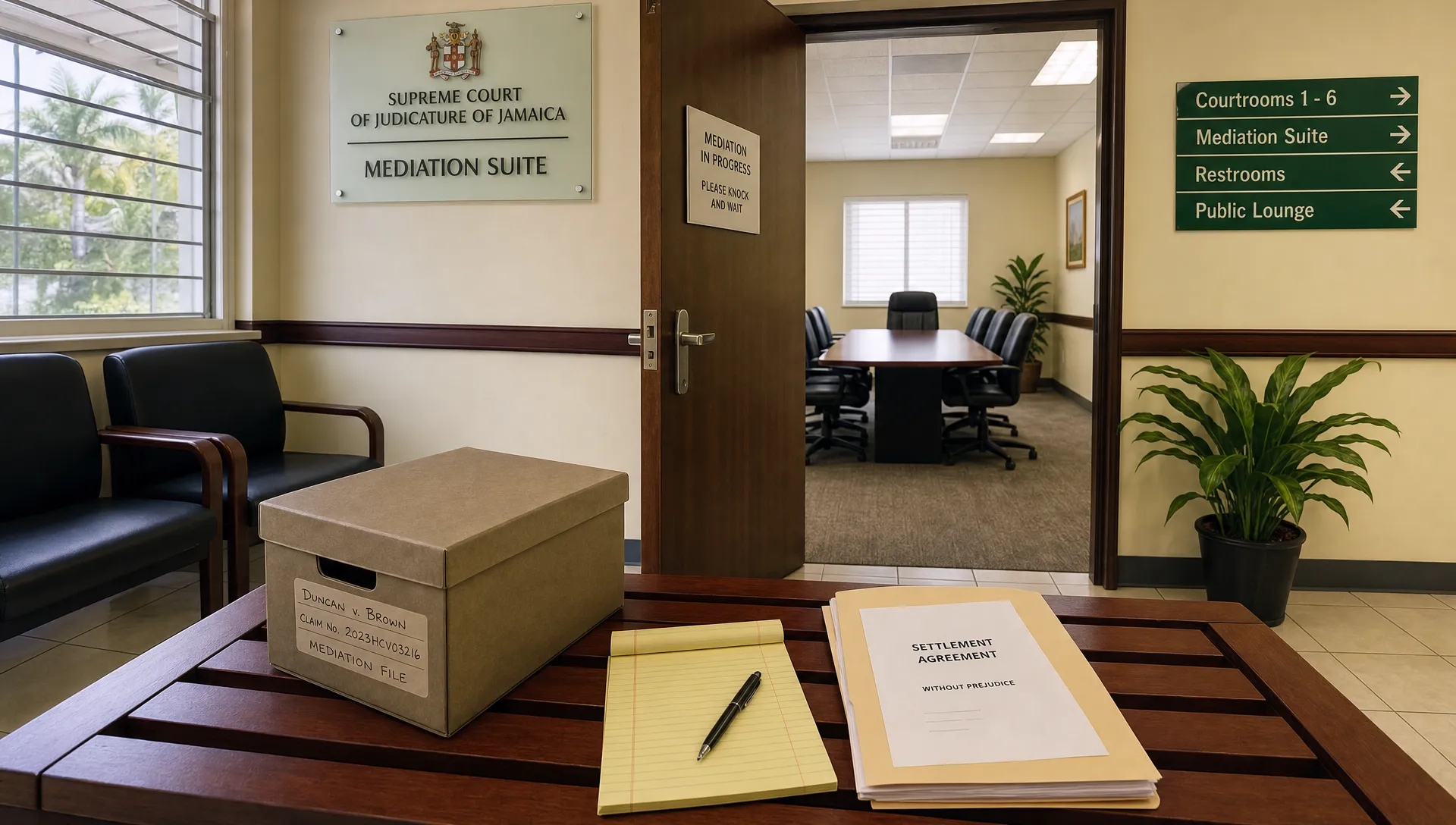
In Jamaican civil litigation, mediation is not simply a courtesy or an optional conversation after pleadings close. Under Jamaica’s Civil Procedure Rules, it sits within the court’s wider responsibility to manage cases fairly, proportionately and efficiently. That means parties should treat mediation as a serious procedural stage, not a break from litigation.
For claimants, defendants, insurers, companies and individuals, the practical point is straightforward: mediation can change the direction, cost and timetable of a dispute. A well-prepared party can use it to resolve the claim, narrow the issues, protect commercial relationships or test the strengths and weaknesses of the case before trial costs escalate.
This article explains how mediation fits within Jamaica’s civil procedure framework, what parties should prepare, and why ignoring mediation can be a costly strategic mistake.
Why mediation matters under Jamaica’s Civil Procedure Rules
The Civil Procedure Rules were designed to move litigation away from delay and technicality toward active case management. The court is concerned not only with who is legally right, but also with whether the dispute is being handled in a way that is proportionate to its value, complexity and importance.
That is why mediation sits naturally within the CPR. It supports the efficient use of court resources, encourages early evaluation and gives parties an opportunity to resolve matters without the delay and uncertainty of trial. The Judiciary of Jamaica publishes the Civil Procedure Rules for reference, and parties should always check the current rules, practice directions and any specific order made in their case.
The core idea is not that every case must settle. Some disputes require a trial because there is a serious factual conflict, an important legal issue, urgent relief or a party who simply will not engage realistically. The point is that the CPR encourages parties and the court to consider whether mediation is appropriate before the matter consumes more time and expense.
Where mediation fits in the life of a civil claim
Mediation can arise at different points in a dispute. Sometimes parties agree to mediate before a claim is filed. Sometimes the court raises mediation during case management. In other cases, parties decide to mediate after disclosure, witness statements or expert reports have clarified the real issues.
Before proceedings begin, mediation may be one of the sensible steps to take before filing a civil claim, particularly where the parties have an ongoing commercial relationship or where the dispute may be resolved by payment terms, delivery obligations, corrected performance or another practical solution.
Once proceedings are underway, mediation must be managed alongside the litigation timetable. A common mistake is assuming that a mediation referral automatically suspends every obligation in the case. Unless the court orders a stay, variation or extension, parties should assume that deadlines for pleadings, disclosure, witness statements, applications and trial preparation still matter.
Stage of dispute | How mediation may arise | Key procedural point |
Before filing | By agreement, contract clause or negotiation strategy | Limitation periods and evidence preservation still matter |
After claim and defence | By party request or court direction | Pleadings help define the issues for settlement |
Case management | As part of the court’s control of the timetable | Parties should clarify deadlines and attendance requirements |
After disclosure or evidence | By renewed agreement when risks become clearer | Mediation can focus on narrowed issues and realistic outcomes |
Close to trial | As a final settlement opportunity | Preparation must continue unless the court orders otherwise |
The most effective timing depends on the dispute. Early mediation can save significant cost, but it may fail if the parties do not yet understand the evidence. Later mediation can be more informed, but by then parties may have already incurred substantial legal fees.
What a court direction to mediate usually changes
When mediation is addressed under the CPR, the court’s order or direction becomes central. It may set a timeframe, require parties to attend, identify steps for selecting a mediator, or direct the parties to report whether the matter has settled. The exact content of the order matters, so parties should read it carefully and seek legal advice where needed.
A mediation direction does not convert the mediator into a judge. The mediator does not decide who wins. The mediator helps the parties explore settlement, assess risk and communicate more effectively. The power to settle remains with the parties.
However, a court-linked mediation process does affect litigation strategy. Parties should be ready to explain their case coherently, understand the remedies being sought, estimate trial risk and make decisions with authority. A representative who attends without settlement authority may frustrate the process and undermine the party’s credibility.
Parties unfamiliar with the practical steps can benefit from understanding what to expect from mandatory mediation in Jamaica, including who should attend, what documents may be useful and how to approach the session.
Preparing for mediation under the CPR
Preparation for mediation is different from trial preparation, but the two are connected. At trial, the focus is proof. At mediation, the focus is risk, interests and acceptable outcomes. A party that only prepares legal arguments may miss the commercial or practical solution that could resolve the dispute.
At the same time, mediation is not guesswork. The stronger the preparation, the more persuasive the party’s position. Before the session, each side should understand the pleaded issues, the evidence likely to matter, the range of possible court outcomes and the cost of continuing.
Useful preparation usually includes:
A concise summary of the claim, defence and key legal issues.
The main documents needed to understand liability and loss.
A realistic assessment of strengths, weaknesses and evidential gaps.
A settlement range, including best case, acceptable compromise and walk-away position.
Clear authority from the decision-maker, insurer, board, director or relevant principal.
Draft settlement terms where the case is capable of practical resolution.
Good preparation also means thinking beyond money. A settlement may involve payment schedules, confidentiality, releases, delivery of goods, transfer of documents, undertakings, apologies, corrective steps or a revised business arrangement. The court can award legal remedies, but mediation can often produce more flexible outcomes.

Confidentiality and without prejudice discussions
Confidentiality is one of mediation’s main advantages. It allows parties to speak more frankly than they might in open court. In many mediations, discussions are conducted on a without prejudice basis, meaning settlement communications generally cannot be used as admissions if the case does not settle.
Still, parties should not treat confidentiality as unlimited. The terms of the mediation agreement, the court’s order, applicable law and public policy may affect what remains confidential and what may need to be disclosed. For example, the fact that a mediation occurred, whether it settled, and any formal consent order may be reportable to the court depending on the circumstances.
This is why legal advice matters before and during mediation. A party should understand what can be said safely, what should be reserved, and how any settlement should be recorded so that it is enforceable.
What happens if mediation produces a settlement
If mediation succeeds, the next question is how to turn the agreement into a binding resolution of the claim. A handshake or informal email may not be enough, especially in commercial, property, banking, employment-related or multi-party disputes.
Settlement terms should be clear on the parties, payment amounts, deadlines, releases, confidentiality, costs, interest, default consequences and whether the claim will be discontinued or resolved by consent order or judgment. Where court proceedings are already active, the settlement may need to be reflected in a formal filing or order so that the court’s record is properly addressed.
Partial settlement is also valuable. Even if the entire case is not resolved, mediation may narrow the dispute. The parties may agree on some facts, abandon certain issues, settle a counterclaim, define the documents needed, or agree on a payment into court or interim arrangement. That can shorten trial and reduce costs.
What happens if mediation fails
A failed mediation is not necessarily wasted. It may clarify what the dispute is really about, reveal weaknesses in a party’s evidence, expose unrealistic expectations or encourage later settlement after further documents are exchanged.
If no settlement is reached, the case normally returns to the litigation track, subject to any court order. The mediator should not be expected to reveal the substance of confidential discussions. Typically, what matters procedurally is whether the case settled, did not settle, or settled in part, along with any information the court has required to manage the proceedings.
After an unsuccessful mediation, parties should immediately review the timetable. If deadlines were paused or extended, confirm the new dates. If no stay was granted, assume the original case management obligations continue unless the court orders otherwise.
Costs, conduct and the risk of refusing mediation
Mediation under the civil procedure rules also has a cost dimension. Courts are concerned with proportionality. If a party refuses to mediate without good reason, delays the process, attends without authority or uses mediation tactically to obstruct progress, that conduct may become relevant when the court considers costs or further case management orders.
This does not mean a party must settle a weak case or accept an unreasonable offer. It does mean parties should be able to justify their approach. A reasonable refusal may exist where urgent injunctive relief is needed, where one party requires disclosure before meaningful discussion, where there is a point of law that must be determined, or where the other side is plainly not engaging in good faith.
The safer approach is to record the reasons for the party’s position, continue to comply with court deadlines and remain open to mediation if circumstances change.
Cases where mediation is especially useful
Mediation is often effective where the dispute involves more than a strict legal remedy. Commercial disagreements, shareholder disputes, professional services claims, construction disputes, debt and banking matters, intellectual property conflicts, family business disagreements and ongoing supply relationships may all benefit from a confidential settlement process.
It is also useful where parties need speed. A trial may determine liability eventually, but a negotiated agreement can provide cash flow, certainty and operational stability much sooner.
Mediation may be less suitable, or may require careful handling, where there is a major power imbalance, allegations of fraud, a need for urgent court protection, a public interest issue, or a party who lacks capacity or authority to settle. Even then, mediation may still assist if the process is structured carefully and legal safeguards are in place.
The role of lawyers in CPR mediation
A lawyer’s role in mediation is not to turn the session into a trial. It is to protect the client’s legal position while helping the client make informed decisions. That includes identifying legal risk, preparing the mediation brief, advising on offers, testing proposed terms and ensuring any agreement is properly documented.
The best mediation advocacy is usually practical, disciplined and commercially aware. Overstatement can harden positions. Under-preparation can weaken leverage. The goal is to present a credible case while leaving room for resolution.
For businesses, this is particularly important because settlement terms can affect tax, security, cash flow, reputation, regulatory obligations and future dealings. For individuals, the consequences may include property rights, debt exposure, confidentiality and enforceability.
Practical checklist before attending mediation
Before attending mediation under the CPR, parties should ask themselves several practical questions. Who has authority to settle? What documents must be reviewed? What outcome is commercially acceptable? What happens if no settlement is reached? Are court deadlines protected? Has the client considered legal costs to trial?
The answers should be discussed before the mediation begins. Many poor outcomes occur because parties arrive without authority, without numbers, without documents or without a realistic view of litigation risk.
Frequently Asked Questions
Is mediation mandatory under Jamaica’s Civil Procedure Rules? Mediation may be directed or strongly encouraged by the court in appropriate civil cases. Whether it is mandatory in a particular matter depends on the rules, any applicable practice direction and the specific order made in the case.
Does mediation stop the court timetable? Not automatically. Unless the court orders a stay, extension or variation, parties should continue to comply with CPR deadlines. Always check the mediation order and the current case management timetable.
Can what I say in mediation be used against me at trial? Mediation discussions are commonly confidential and conducted on a without prejudice basis, but the protection depends on the mediation agreement, the court order and applicable law. Legal advice should be obtained before making sensitive admissions or offers.
What if the other side attends mediation but refuses to negotiate seriously? The court may be concerned with conduct that wastes time or increases costs. The appropriate response depends on the facts, but parties should keep complying with court directions and seek advice on whether further orders or costs arguments are available.
Should I mediate before filing a claim? Sometimes, yes. Early mediation can save costs and preserve relationships, but it should not cause a party to miss limitation deadlines, lose evidence or weaken its position. Pre-filing strategy should be considered carefully.
Need guidance on mediation or civil litigation in Jamaica?
Mediation under Jamaica’s Civil Procedure Rules is most effective when it is approached with legal strategy, procedural discipline and a realistic understanding of risk. Whether you are considering mediation before filing a claim, responding to a court direction or preparing for a commercial dispute, tailored advice can make a significant difference.
For assistance with civil litigation, commercial disputes, arbitration or mediation strategy, you may contact Henlin Gibson Henlin to discuss your matter with an experienced Jamaican legal team.