
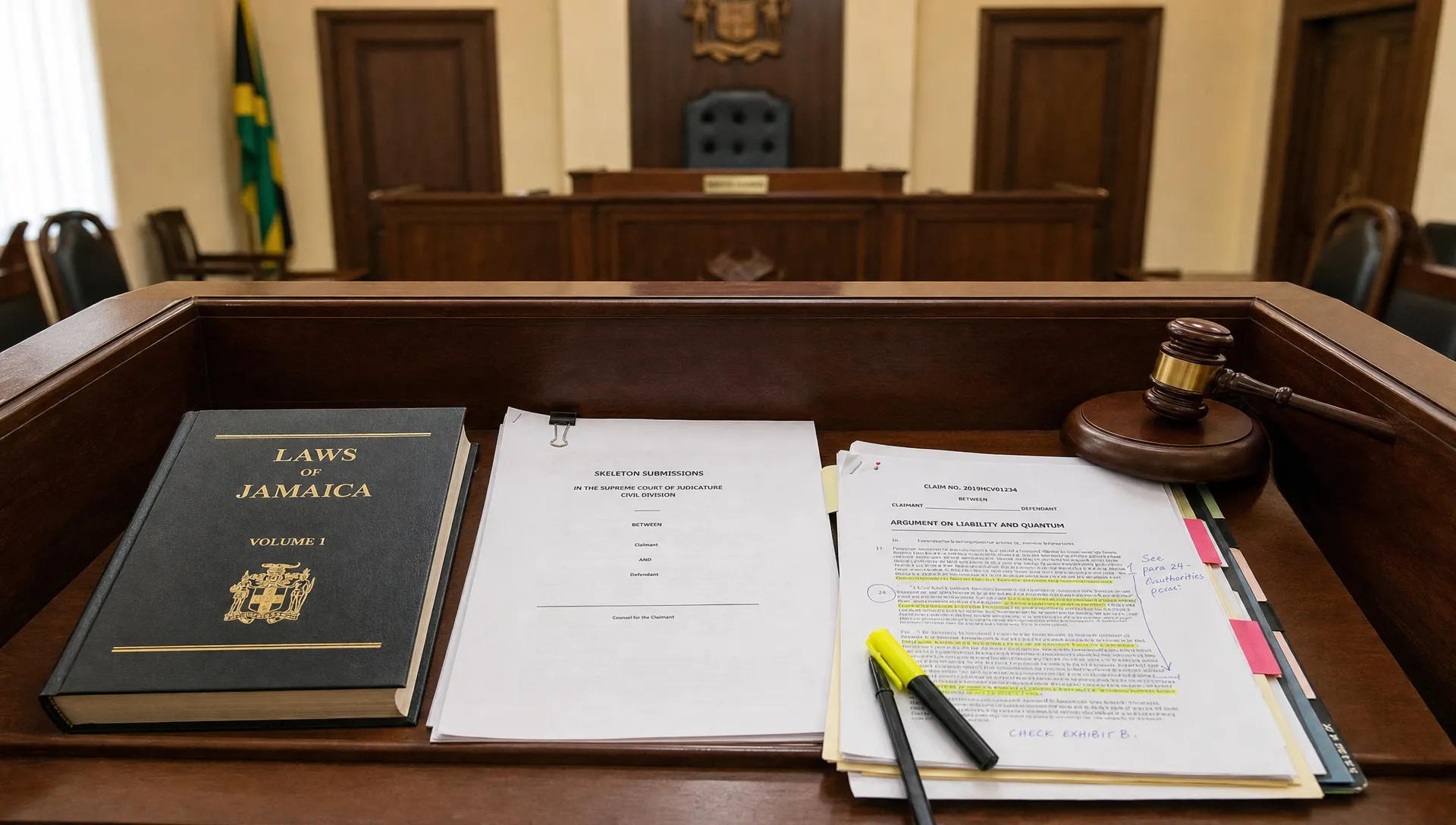
When clients hear the phrase advocate law, they often picture a lawyer standing in court, cross-examining a witness or making submissions to a judge. That is part of it, but in Jamaican courts advocacy is much broader. It includes the judgement, preparation, strategy, procedural knowledge, negotiation, and ethical discipline that guide a case from the first consultation to judgment, settlement, or appeal.
In Jamaica, legal practitioners are generally admitted as attorneys-at-law. Unlike some jurisdictions where the profession is formally split between solicitors and barristers, a Jamaican attorney may advise clients, draft documents, negotiate, and appear in court. So when clients ask what advocate law means, the practical question is this: what should effective courtroom representation do for you, and what should you expect from the attorney handling your matter?
This article explains advocate law from the client’s point of view, especially in civil and commercial disputes before Jamaican courts.
Advocate law in Jamaica is about representation with judgement
Advocacy is not simply speaking forcefully. In court, an advocate’s role is to help the decision-maker understand the legal and factual issues that matter, while protecting the client’s position within the rules of law and professional ethics.
That means an advocate must usually do several things at once. They must understand the client’s commercial or personal objectives, identify the legal issues, assess evidence, follow court procedure, present arguments clearly, and advise on the risks of continuing, settling, appealing, or enforcing a judgment.
For clients, the value of advocate law is often found in the choices made before anyone rises to speak in court. A well-prepared case is usually built long before a hearing date. Pleadings, witness statements, affidavits, applications, disclosure, and legal submissions all shape the outcome.
Jamaica’s legal system is rooted in the common law tradition, where precedent, procedure, evidence, and judicial reasoning play a central role. If you want a broader overview of the court structure and common law background, Henlin Gibson Henlin’s guide to Jamaica’s legal system provides useful context.
What an advocate does for clients before court
Many clients first contact an attorney when a dispute has already escalated. A claim may have been filed. A demand letter may have arrived. A bank, business partner, regulator, insurer, shareholder, customer, or contractor may be threatening action. At that point, advocacy begins with careful diagnosis.
A good advocate should not simply ask, “How do we win?” The better first questions are usually, “What must be proved?”, “What documents exist?”, “What is the commercial objective?”, “What are the legal risks?”, and “Which procedure gives the client the best realistic path forward?”
Before court hearings, advocate law may involve:
Reviewing contracts, correspondence, financial records, policies, and statutory obligations.
Identifying the proper cause of action or defence.
Advising on limitation periods, urgency, interim relief, and procedural deadlines.
Preparing pleadings, affidavits, witness statements, and submissions.
Preserving evidence, including electronic records and communications.
Considering settlement, mediation, arbitration, or other dispute resolution options.
This preparation matters because Jamaican courts, like other common law courts, decide cases based on admissible evidence, applicable law, and procedure. A client may feel morally right, but the legal case must still be pleaded, supported, and proved.
What advocate law means during hearings and trials
In hearings and trials, the advocate becomes the client’s voice before the court. But that voice must be disciplined. Judges are not persuaded by volume, emotion, or broad accusations. They are persuaded by relevant facts, coherent legal arguments, reliable evidence, and answers to the questions the court must decide.
Depending on the case, an advocate may handle applications for injunctions, summary judgment, strike-out, disclosure, security for costs, extensions of time, or other procedural matters. At trial, advocacy may include opening statements, examination-in-chief, cross-examination, re-examination, objections, legal submissions, and closing arguments.
Each stage requires a different skill. Cross-examination, for example, is not just asking difficult questions. It requires control, preparation, and a clear theory of the case. Written submissions require precision. Oral submissions require judgement about what to emphasise, what to concede, and how to assist the court without overstating the case.
Stage of the case | What the advocate focuses on | Why it matters to the client |
Early assessment | Merits, risks, evidence, urgency, and objectives | Helps avoid weak claims, missed deadlines, and unnecessary costs |
Pleadings | Clear claims, defences, remedies, and legal issues | Defines what the court will decide |
Evidence preparation | Documents, witnesses, affidavits, expert material, and admissibility | Strengthens proof and reduces surprises |
Interim applications | Urgent relief, procedural protection, or narrowing issues | Can preserve assets, rights, or strategic advantage |
Trial or hearing | Persuasive presentation of facts and law | Gives the client’s case its best fair opportunity |
Appeal or enforcement | Legal error, judgment execution, or post-judgment strategy | Determines whether the result can be challenged or made practical |
The client’s role in effective advocacy
Clients sometimes assume that advocacy is entirely the attorney’s responsibility. In reality, strong advocacy depends heavily on the quality of the client’s instructions and records.
The attorney can assess the law, prepare the case, and speak in court, but the client usually holds the factual history. Emails, invoices, contracts, meeting notes, bank records, internal policies, WhatsApp messages, photographs, and witness names may all become important. The sooner those materials are identified and organised, the better the advocate can understand the case.
Clients should also be candid. Surprises are dangerous in litigation. If there is an unfavourable document, a missed payment, a prior admission, a regulatory issue, or a witness problem, the attorney needs to know early. An advocate can often manage difficult facts if they are disclosed in time. Hidden facts that emerge during cross-examination or disclosure can damage credibility and strategy.

Advocate law is not always about going to trial
One of the most important parts of advocate law is knowing when a courtroom battle is not the best route. Effective advocacy may involve negotiation, mediation, arbitration, or a carefully structured settlement. In commercial matters, preserving a business relationship or limiting financial exposure may be more valuable than pursuing every possible argument to trial.
Jamaican courts and dispute resolution processes increasingly recognise the value of narrowing issues and encouraging settlement where appropriate. This does not mean weakness. It means strategy. A capable advocate should help the client understand the difference between a principled settlement, a poor compromise, and a case that truly needs judicial determination.
In some cases, urgent court action is unavoidable. In others, a strong pre-action letter, negotiation strategy, or mediation may resolve the dispute faster and with less disruption. The key is not choosing litigation or settlement automatically, but choosing the path that best serves the client’s lawful objective.
How court level and forum affect advocacy
Advocate law also depends on where the matter is being heard. The style, procedure, and strategy may differ depending on whether the case is in a Parish Court, the Supreme Court, the Commercial Division, the Court of Appeal, an arbitral tribunal, or another forum.
A debt claim, shipping dispute, shareholder dispute, constitutional matter, injunction application, intellectual property dispute, banking claim, employment-related claim, or appeal may each require a different approach. Some matters turn heavily on documents. Others depend on witness credibility. Some are legally technical. Others are urgent because assets, confidential information, contractual rights, or business operations are at risk.
This is why clients should not treat advocacy as a generic service. The advocate must understand both the law and the forum. Procedural missteps can affect timing, cost, admissibility, and even the client’s ability to obtain a remedy.
For a closer look at case preparation in litigation, Henlin Gibson Henlin has explained how attorneys in civil litigation teams prepare strong cases, including issue-framing, evidence management, pleadings, and procedural planning.
Professional duties shape what an advocate can and cannot do
Clients sometimes want a lawyer who will “fight by any means necessary.” That is not how proper legal advocacy works. Attorneys owe duties to their clients, but they also owe duties to the court and to the administration of justice.
The General Legal Council is the regulatory body for the legal profession in Jamaica, and attorneys are expected to comply with professional standards. This matters because ethical advocacy protects the integrity of the process and, ultimately, the client’s case. Misleading the court, advancing arguments without a proper basis, suppressing relevant obligations, or abusing procedure can create serious consequences.
Strong advocacy is not reckless aggression. It is firm, prepared, strategic, and ethical representation. Often, the most effective advocate is the one who knows which points to press, which points to abandon, and how to maintain credibility with the court.
What clients should expect from a strong court advocate
A client should expect more than courtroom attendance. Good advocate law services should help the client understand the case, participate meaningfully in decisions, and prepare for the realities of litigation.
In practical terms, clients should look for:
Clear advice on strengths, weaknesses, cost exposure, and realistic outcomes.
A strategy that connects legal arguments to the client’s commercial or personal objective.
Careful preparation of pleadings, evidence, submissions, and witnesses.
Responsiveness about deadlines, hearings, and next steps.
Candour when the case changes, new evidence emerges, or settlement becomes sensible.
The best attorney-client relationships are not built on promises of guaranteed victory. They are built on trust, preparation, competence, and honest judgement. Courts are inherently uncertain, but a strong advocate reduces avoidable risk and improves the quality of the client’s presentation.
Common misconceptions about advocate law
One misconception is that advocacy begins only when a matter reaches trial. In reality, many cases are won, lost, narrowed, or settled through early decisions about pleadings, evidence, and procedure.
Another misconception is that the most aggressive advocate is always the best advocate. Aggression without judgement can increase costs, irritate the court, damage negotiations, and distract from the real issues. Effective advocacy is targeted.
A third misconception is that clients do not need legal advice until court papers are filed. That delay can be costly. Early legal advice may help preserve evidence, avoid admissions, meet deadlines, prevent escalation, or position the client for settlement.
If you are unsure whether your matter has reached the point where legal representation is needed, this guide on when to hire attorneys for civil matters in Jamaica outlines common warning signs, including urgent disputes, court documents, contract breaches, and money or property issues.
When clients should seek advocate law support
Clients should consider speaking with an attorney as soon as a dispute becomes legally or financially significant. This includes situations where court proceedings have started, deadlines are approaching, important documents must be preserved, a contract has been breached, confidential information is at risk, a regulator is involved, or an appeal may be necessary.
Businesses should be especially careful about waiting too long. Commercial disputes can affect cash flow, reputation, supply chains, shareholder rights, financing arrangements, and regulatory exposure. Individuals should also act promptly where property, inheritance, employment, family assets, debt, professional reputation, or personal rights are involved.
Advocate law is ultimately about protecting a client’s position through informed strategy and skilled representation. The earlier that strategy is built, the more options the client may have.
Frequently Asked Questions
Is “advocate” a separate legal profession in Jamaica? In Jamaica, legal practitioners are generally admitted as attorneys-at-law. An attorney may provide advice, prepare documents, negotiate, and appear in court, subject to the relevant rules and the nature of the matter.
What does advocate law mean for a client going to court? It means having legal representation that prepares and presents the client’s case through pleadings, evidence, legal submissions, court procedure, negotiation, and trial or appellate advocacy where required.
Does every dispute need a court advocate? Not every dispute needs a trial, but many disputes benefit from early legal advice. An advocate can assess whether negotiation, mediation, arbitration, urgent court action, or a full claim is the best path.
Can an advocate guarantee a result in court? No. Court outcomes depend on the facts, evidence, law, procedure, witnesses, judicial assessment, and sometimes the opposing party’s conduct. A responsible attorney should explain risks and prospects, not guarantee victory.
When should I contact an attorney about a Jamaican court matter? You should seek advice promptly if you receive court papers, face a legal deadline, need urgent relief, are involved in a significant contract or commercial dispute, or believe an appeal may be necessary.
Speak with a Jamaican litigation team about your case
Understanding advocate law helps clients make better decisions before and during litigation. The right legal team should not only speak for you in court, but also help you understand your risks, organise your evidence, choose the right strategy, and protect your position at every stage.
Henlin Gibson Henlin provides client-focused legal services across areas including commercial litigation, civil litigation, arbitration and mediation, appellate matters, banking litigation, intellectual property, data privacy, compliance and risk, and admiralty and shipping. If your matter may require court representation or strategic dispute resolution in Jamaica, consider seeking tailored legal advice before important deadlines or procedural steps pass.