
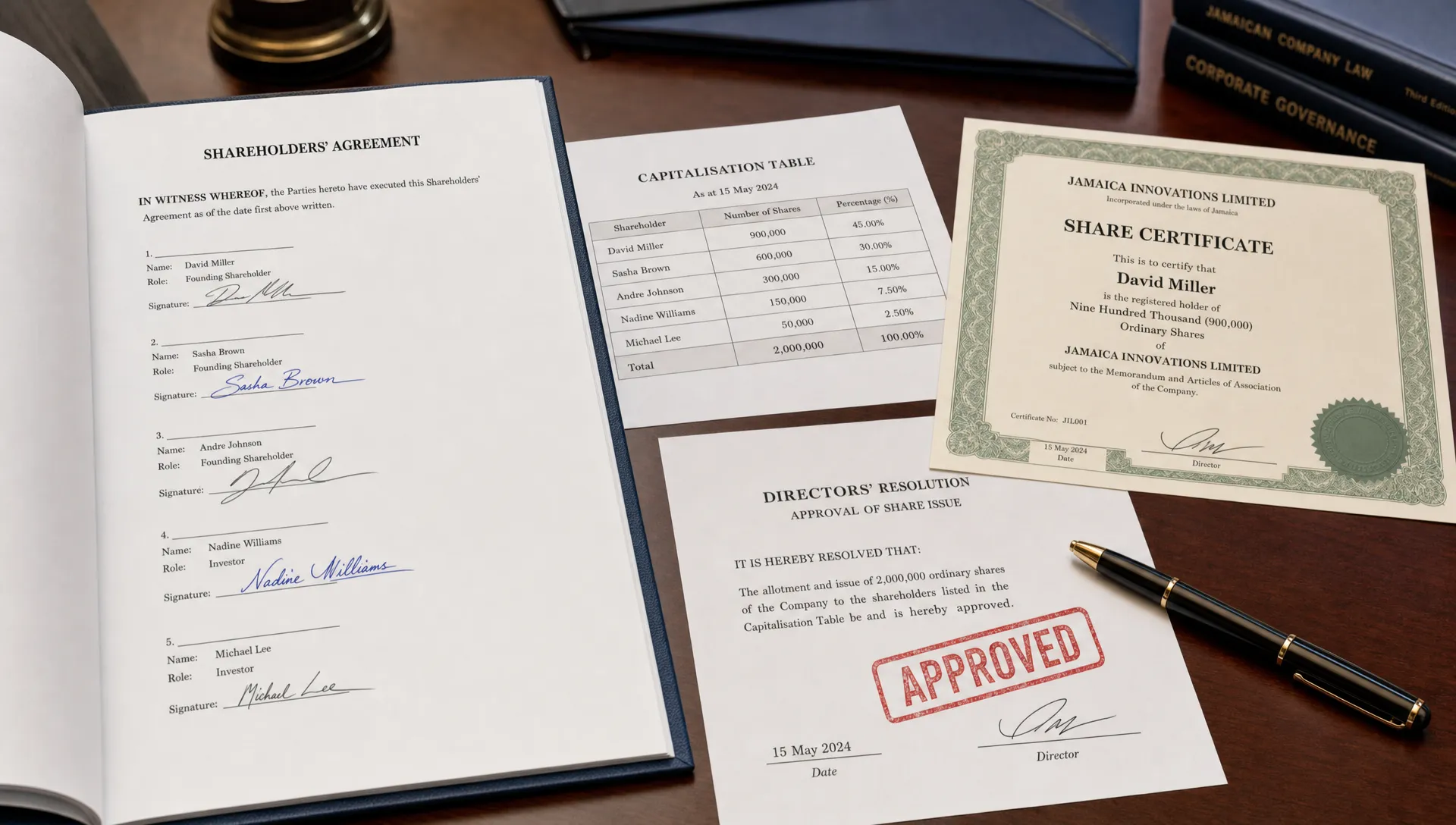
A shareholders' agreement is one of the most useful legal documents a company can put in place before relationships are tested. It sits alongside the company's articles and corporate records, helping owners agree how decisions will be made, how shares may be transferred, what happens if someone wants out and how disputes will be handled.
For Jamaican companies, the value is practical as much as legal. Many businesses start with trust, family ties or a promising commercial opportunity. Those foundations matter, but they do not answer every future question. If a founder stops contributing, a minority investor feels excluded or a buyer wants to acquire one shareholder's stake, a well drafted agreement can prevent uncertainty from becoming expensive conflict.
This guide explains the main clauses to consider. It is general information, not legal advice, and the right wording will depend on the company's structure, industry, financing and shareholder mix.
Why a shareholders' agreement matters
A company's articles provide a formal governance framework, but they rarely cover every commercial expectation between owners. A shareholders' agreement can go further by setting out private arrangements on voting, funding, board control, exit rights, confidentiality and dispute resolution.
It is especially valuable where there are founder shareholders, family shareholders, minority investors, joint venture partners or silent investors. In each case, the owners may have different levels of involvement, different risk appetites and different ideas about when profits should be reinvested or distributed.
The agreement should not be treated as a substitute for proper company filings or statutory records. In Jamaica, corporate filings and registered company information are handled through the Companies Office of Jamaica, while the company's internal governance must still be maintained properly. The agreement should fit with the Companies Act, the articles, board resolutions and any financing documents.
What to include in a shareholders' agreement
The best shareholders' agreements are not generic templates with names inserted. They reflect how the business will actually operate, who has economic risk and where future disagreement is most likely.
Parties, background and purpose
Start by identifying the company and each shareholder who will be bound. If the company itself is also a party, the agreement can impose obligations on the company, such as providing reports or maintaining insurance, subject to company law limits.
The background section should explain the commercial context without becoming too long. For example, it may state that the shareholders are establishing a company to operate a specific business, hold particular assets or pursue an identified project. This helps interpretation if a dispute later arises.
A strong opening section should also confirm the relationship between the agreement and the company's articles. If the two documents conflict, the agreement should say which obligation the shareholders must take steps to amend, provided the law allows it.
Share capital, ownership and contributions
The agreement should record who owns what at the outset. This includes the number and class of shares held by each shareholder, any subscription price and any conditions attached to those shares.
If a shareholder is contributing more than cash, spell that out carefully. Contributions might include intellectual property, customer relationships, equipment, land use, technical skill, management time or regulatory connections. Vague promises such as business development support or operational assistance often create disputes because no one can prove what was actually required.
Where future funding is expected, the agreement should say whether shareholders must contribute in proportion to their shareholdings, whether loans are allowed and what happens if a shareholder cannot or will not participate in a funding round.
Governance, board control and management roles
A shareholders' agreement should separate ownership from management. A shareholder may own shares but have no day to day management role. Another may be a working founder with operational responsibilities and employment obligations.
The agreement should address board composition, appointment rights, removal rights and quorum. If particular shareholders have the right to appoint directors, the document should explain when that right begins and ends. For example, it may depend on maintaining a minimum ownership percentage.
It should also make clear which decisions are for management, which are for the board and which need shareholder approval. This avoids a common problem in closely held companies where every operational issue becomes a shareholder argument.
For Jamaican companies, governance evidence matters. Board approvals, delegated authority and major decisions should be reflected in proper minutes. Henlin Gibson Henlin has written separately on board minutes that help protect Jamaican companies, which is a useful companion issue when drafting governance provisions.
Reserved matters and voting thresholds
Reserved matters are decisions that cannot be taken without a higher approval threshold. These clauses are especially important for minority protection and investor confidence.
Typical reserved matters may include issuing new shares, changing the articles, borrowing above a set amount, selling major assets, entering related party transactions, approving budgets, hiring or removing senior executives and starting litigation.
The threshold should match the risk. Requiring unanimous consent for every major decision may sound protective, but it can paralyse the company. A more workable approach may be supermajority approval, approval by a named investor or approval by shareholders holding a stated percentage of shares.
Protecting ownership, exits and value
Ownership clauses are where many shareholder disputes are either prevented or created. The agreement should make it difficult for an unwanted third party to enter the company, but not so difficult that no shareholder can ever exit.
Restrictions on share transfers
Most shareholders do not want their business partner to sell shares to a competitor, creditor or unknown buyer without controls. A shareholders' agreement commonly restricts transfers unless specific procedures are followed.
The agreement may include rights of first refusal, rights of first offer, permitted transfers to affiliates or family trusts and restrictions on pledging shares as security. If there are foreign shareholders, regulated industries or lender covenants, transfer provisions should also take account of approvals that may be needed before a transaction can close.
A transfer clause should explain the process clearly: notice, price, timing, acceptance, completion and what happens if the sale does not proceed. Ambiguity at this stage can delay deals and increase the risk of injunction applications or claims for breach.
Valuation and buyout method
A buyout clause is only useful if the parties can determine the price. The agreement should state whether value is based on fair market value, book value, a formula, a multiple of earnings or an independent valuation.
Each method has tradeoffs. Book value may be simple, but it can undervalue a growing services business. A full independent valuation may be fairer, but it can be slower and more expensive. In founder companies, different valuation rules may apply depending on whether a departure is friendly, forced or caused by misconduct.
Issue | Drafting choice | Why it matters |
Valuer appointment | Single expert, joint appointment or court appointed fallback | Prevents delay if shareholders cannot agree on the valuer |
Valuation date | Date of notice, date of breach or financial year end | Stops parties from manipulating timing |
Discounts | Minority discount, control premium or no discount | Can significantly change the exit price |
Payment terms | Lump sum, instalments or escrow | Balances fairness with company cash flow |
Dispute process | Expert determination, mediation or arbitration | Keeps valuation disagreements from overwhelming the business |
Dividends, reinvestment and financing
Disputes often arise when one shareholder wants dividends and another wants to reinvest profits. The agreement cannot force unlawful distributions, but it can set expectations on dividend policy, budget approval and reinvestment priorities.
Funding obligations also need attention. If the company needs additional capital, the agreement should say whether shareholders are obliged to contribute, whether dilution applies if they do not and whether shareholder loans carry interest. Without these provisions, urgent funding needs can become leverage for one shareholder over another.

Minority protections and founder safeguards
A good agreement balances control with fairness. Majority shareholders need the company to function, but minority shareholders need protection against exclusion, dilution and unfair related party transactions.
Information rights and inspection
Minority shareholders often need access to reliable information to protect their investment. The agreement can require periodic management accounts, annual financial statements, budgets, tax compliance updates and notice of material contracts.
These rights should be practical. A small company may not be able to produce complex monthly reporting, but it can usually provide bank statements, management accounts or quarterly updates. The agreement should also preserve confidentiality, especially where a shareholder has other business interests.
If relations deteriorate, records become central. Henlin Gibson Henlin's article on shareholder disputes and the records that matter most explains why governance documents, financial records and communications often shape the outcome of corporate disputes.
Founder vesting and leaver provisions
In start ups and founder led companies, shareholders sometimes receive equity because they are expected to work in the business. If a founder leaves after a short period but keeps the full shareholding, the remaining founders may feel trapped.
Vesting provisions can address this by allowing shares to vest over time or by creating buyback rights if a founder leaves early. Leaver provisions can also distinguish between good leavers, such as someone leaving because of illness, and bad leavers, such as someone dismissed for serious misconduct.
These clauses must be drafted carefully. Overly punitive buyback rights can be challenged, and vague misconduct wording can create new disputes instead of solving old ones.
Confidentiality, intellectual property and restraints
Shareholders may receive access to client lists, pricing, product plans, trade secrets, financial records and strategic opportunities. The agreement should include confidentiality obligations that continue after a shareholder exits.
If intellectual property is central to the business, the agreement should state who owns it and whether any shareholder must assign rights to the company. This is particularly important in technology, media, professional services, manufacturing and brand driven businesses.
Restrictive covenants, such as non-compete and non-solicitation clauses, should be reasonable in scope, geography and duration. A clause that goes further than necessary may be harder to enforce. For businesses that need separate confidentiality terms with employees, contractors or commercial partners, this practical guide to confidentiality agreements in Jamaica is a helpful reference.
Handling disputes before they damage the company
Even carefully drafted agreements cannot guarantee harmony. They can, however, provide a sequence for handling disagreement before operations stall or relationships collapse.
Deadlock clauses
A deadlock occurs when required approvals cannot be obtained. This is common in 50-50 companies, joint ventures and companies where veto rights apply to major decisions.
A deadlock clause should define what counts as deadlock and how it is resolved. Options include escalation to senior representatives, mediation, rotating chair decisions, buy-sell mechanisms or a winding up trigger as a last resort.
The right approach depends on the company. A shotgun buy-sell clause may be inappropriate where one shareholder has far greater financial strength. A mediation first clause may be better where the shareholders still need to preserve a commercial relationship.
Arbitration, mediation and court proceedings
Dispute resolution clauses should be clear and workable. Mediation can help shareholders reach a commercial solution without immediately moving into adversarial proceedings. Arbitration may provide privacy and specialist decision making, but it must be drafted with care so that the seat, rules, appointment process and interim relief options are clear.
Some disputes may still require court intervention, particularly where urgent injunctions, statutory remedies or corporate filings are involved. The agreement should not pretend that every issue can be handled privately if the law requires otherwise.
For companies with cross-border shareholders, dispute clauses deserve extra attention. Governing law, jurisdiction, enforcement and service of notices can all affect whether the clause works when pressure is high.
Remedies for breach
A shareholders' agreement should explain what happens if a shareholder breaches it. Possible remedies include damages, injunctive relief, forced transfer rights, suspension of voting rights or indemnity obligations.
Not every remedy will be appropriate or enforceable in every situation. The key is to make the consequences proportionate and connected to the breach. For example, a confidentiality breach may call for urgent injunctive relief, while failure to fund may lead to dilution or loss of certain consent rights.
Jamaica-specific drafting points
For a Jamaican company, the agreement should be drafted with local corporate law, tax, regulatory and court realities in mind. A foreign precedent may be useful as a starting point, but it should not be copied without adaptation.
Pay close attention to the company's articles. If the articles allow a transfer but the shareholders' agreement restricts it, the parties may need to update the articles or ensure the agreement obliges shareholders to vote in a way that gives effect to the restriction. The same point applies to director appointment rights, quorum, share classes and pre-emption rights.
Also consider whether the business operates in a regulated sector such as financial services, telecommunications, energy, shipping, real estate development or data intensive services. Consent requirements, fit and proper rules, licensing conditions and data protection obligations can affect what shareholders may do with information and control rights.
Finally, make sure notices can actually be served. If shareholders live overseas or use corporate vehicles, the agreement should include reliable notice addresses, email service rules and deemed receipt provisions.
Common mistakes to avoid
Many shareholder agreements fail because they are too vague, too complex or disconnected from the company's real operating model. The most common mistakes are avoidable.
Using a template that conflicts with the articles or financing documents.
Giving veto rights so broad that routine business becomes impossible.
Ignoring what happens if a founder stops working in the business.
Failing to set a valuation method for buyouts.
Allowing share transfers without proper consent procedures.
Treating confidentiality and intellectual property as afterthoughts.
Forgetting to update the agreement after new investment, restructuring or major changes in ownership.
The document should be reviewed whenever the company raises capital, admits a new shareholder, changes its business model, takes on significant debt or enters a major joint venture.
Frequently Asked Questions
Is a shareholders' agreement legally required in Jamaica? A company can exist without one, but many closely held companies benefit from having one. The agreement helps fill gaps in the articles and records the commercial expectations between shareholders.
Should the company be a party to the shareholders' agreement? Often, yes, especially where the company must provide information, observe transfer procedures or implement governance rights. The decision should be made carefully so the company's obligations are lawful and practical.
Can a shareholders' agreement override the company's articles? It should not be drafted on the assumption that it can override the articles or statute. If there is a conflict, the parties may need to amend the articles and ensure the documents work together.
What is the most important clause in a shareholders' agreement? There is no single clause for every company. For many closely held businesses, the most important provisions are transfer restrictions, reserved matters, valuation, deadlock resolution and confidentiality.
When should a shareholders' agreement be prepared? Ideally, it should be prepared before the business begins trading or before new investors come in. It can still be prepared later, but negotiation may be harder once value has increased or disagreements have already appeared.
Getting the agreement right
A shareholders' agreement should protect the business without making it impossible to run. It should be clear enough to guide decisions, flexible enough for growth and aligned with the company's articles, records and commercial reality.
If you are forming a company, admitting an investor, restructuring ownership or facing tension between shareholders, tailored legal advice can help you identify the clauses that matter most. Henlin Gibson Henlin advises on corporate governance, commercial litigation, arbitration and related business law issues in Jamaica. You can learn more about the firm at Henlin Gibson Henlin.